TL;DR: Created by Frank Miller in Daredevil #168 (1981), Marvel’s deadliest Greek assassin grew from a tragic college romance into a complex, headline-carrying antihero. Over four decades, she died, rose again, reshaped street-level comics, mastered twin sai, and eventually claimed the horned cowl of Daredevil herself.
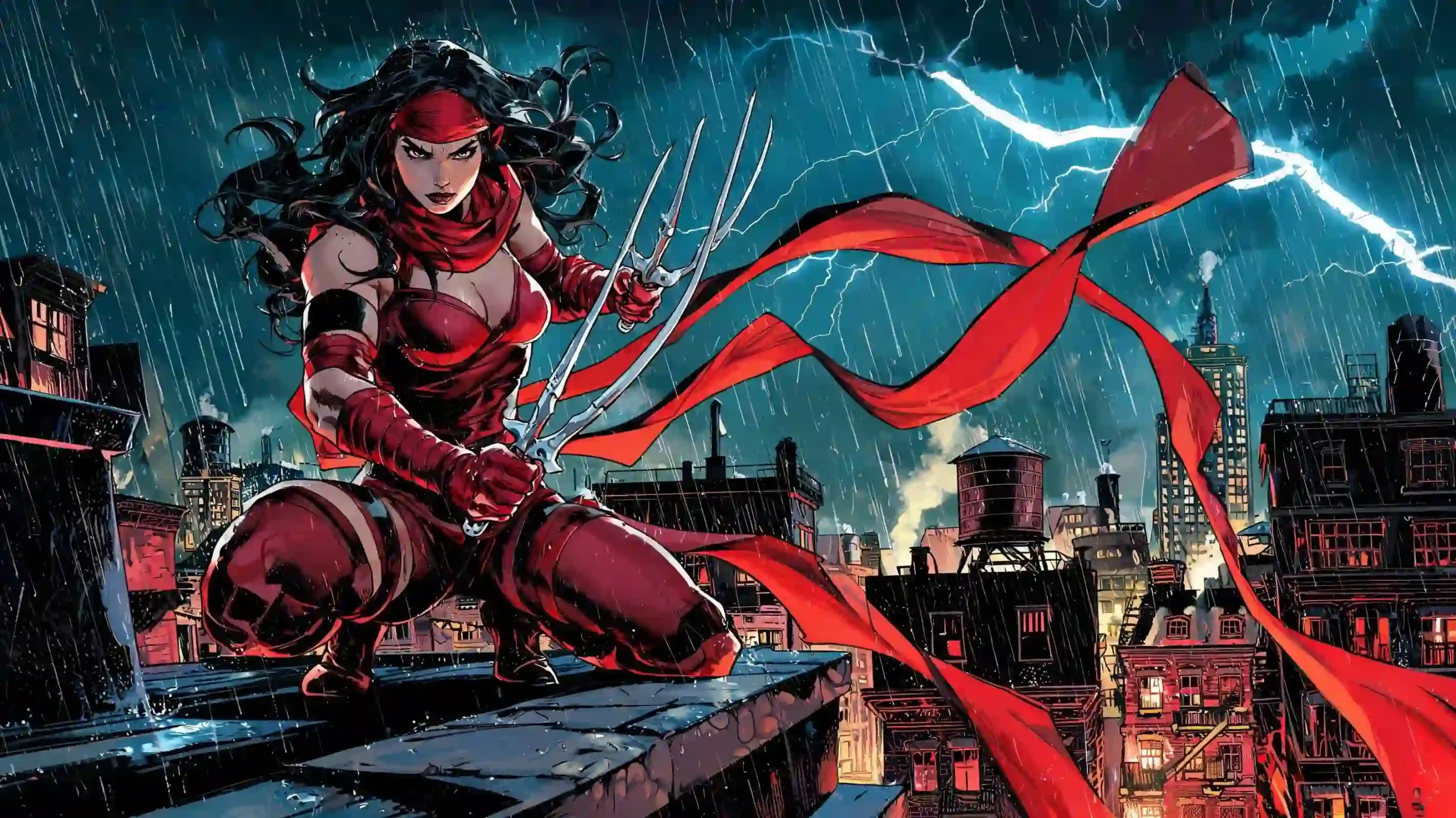
Picture a rain-slicked New York rooftop lit by a single bolt of lightning, a flash of scarlet silk cutting the dark, and the cold glint of twin three-pronged blades. When Elektra Natchios stepped out of the shadows in early 1981, she didn’t just upend Matt Murdock’s carefully ordered life. She rewired what mainstream American superhero comics were allowed to feel like.
Whether you’re picking up your very first Marvel trade paperback, catching up after watching her on screen, or studying character architecture as a writer or collector, you’re in the right place. In this guide, you’ll trace her full path from Frank Miller’s original noir tragedy through her boldest solo runs, learn how her weapons and psychic skills actually work, and get a clear reading order you can start tonight.
Quick Overview
- Family Name & Roots: Natchios, born on a Greek Aegean island to diplomat Hugo Natchios and Christina Natchios
- Creator & First Issue: Written and penciled by Frank Miller (inked by Klaus Janson, edited by Denny O’Neil) in Daredevil Vol. 1 #168 (January 1981)
- Signature Weapons: Twin Okinawan sai, backed by katana, shuriken, three-section staff, and nerve-strike conditioning
- Major Affiliations: The Chaste, the Hand, S.H.I.E.L.D., Thunderbolts, Savage Avengers, and the Fist
- Defining Modern Role: Co-holder of the Daredevil mantle (“The Woman Without Fear”) beginning in Daredevil Vol. 6 #25 (December 2020)
- Lasting Appeal: A fiercely independent antihero caught between lethal pragmatism and a hard-earned choice to protect others
Who Is Elektra and How Did Frank Miller Create Her?
Definition: Born into the prominent Greek Natchios family, Marvel Comics’ premier female assassin debuted in Daredevil #168 (January 1981) as a martial artist, bounty hunter, and eventual vigilante. Trained by both the heroic Chaste and the demonic ninja clan known as the Hand, she bridges hardboiled crime noir, Japanese martial arts drama, and modern superhero redemption stories.
When twenty-three-year-old artist Frank Miller took over solo scripting duties on Daredevil with issue #168, the series wasn’t one of Marvel’s top sellers. Working alongside inker Klaus Janson and veteran editor Denny O’Neil, Miller wanted to trade bright Silver Age spectacle for gritty urban shadows, moral compromises, and sharp emotional stakes. According to a 1983 interview Miller gave to Comics Interview magazine, he originally planned for this mysterious bounty hunter to appear in a single issue and never return. Instead, her chemistry with Matt Murdock burned so brightly that she practically took over the entire book.
Even her debut cover carries a famous piece of publishing trivia that back-issue collectors still point out first. Look closely at the front banner of Daredevil #168 and you’ll spot her name misspelled with an extra “c” right before the interior story locked in the standard spelling. Inside those pages, though, every beat landed with surgical confidence. Miller handed Murdock a lost love who already knew his secret identity, matched his acrobatics move for move, and flatly refused to share his faith in the legal system.
From Greek Tragedy to Street-Level Noir
Why did she feel so different from almost every other female comic book character on newsstands in 1981? For starters, Miller pulled from storytelling traditions far outside costumed superhero fare. He drew her first name and father-haunted fury from the ancient Greek tragedy of Electra, the daughter of King Agamemnon driven to vengeance after her father’s murder. At the same time, her role as a youthful sweetheart hardened into a mercenary paid clear tribute to Sand Saref, the unforgettable femme fatale created by cartoonist Will Eisner in The Spirit.
Visually, she shattered Marvel’s typical house style too. Rather than drawing a delicate damsel or a weightless pinup, Miller based her sinewy shoulders, athletic build, and coiled posture on pioneering female bodybuilder Lisa Lyon. Paired with the crisp, silent panel pacing of Japanese gekiga manga like Kazuo Koike and Goseki Kojima’s Lone Wolf and Cub, the result was a fighter who looked like she could genuinely hurl a grown man through a window. You never read her action scenes wondering who would save her; you wondered whether anyone else in the room would walk out standing.
What Shaped Natchios Before She Put on the Red Bandana?
If you want to understand why Natchios treats mercy like a luxury she can’t afford, you have to rewind to her life before the blades. Raised on a sun-drenched Greek island surrounded by wealth, bodyguards, and political intrigue, she grew up as the fiercely devoted daughter of ambassador Hugo Natchios. Even those early years carried deep fractures, including her mother Christina’s violent death during an attack and the influence of her older brother, Orestez, who pushed her to train in martial arts as a child. By age nineteen, when she enrolled at Columbia University in New York during her father’s diplomatic posting, she already hid a restless storm behind polite manners.
On campus, she collided directly with blind law student Matt Murdock and his best friend Foggy Nelson. Matt won her trust by letting his guard down and revealing his heightened senses, setting off a whirlwind year of rooftop dares, fast drives, and first love. Doesn’t every classic noir romance start with one brief season where two doomed people almost get to be happy? That season ended in gunfire when terrorists seized Natchios and her father inside a campus building, and a jittery police officer outside shot Hugo Natchios dead while Matt struggled to rescue them.
Grief didn’t soften her; it froze something vital inside her chest. Convinced that courts, rules, and emotional attachment were fragile lies, she quit Columbia, walked out of Murdock’s life, and vanished across Europe and East Asia. More than a decade later, in the 1993 miniseries Daredevil: The Man Without Fear, Miller and artist John Romita Jr. revisited those college months with a darker twist, depicting young Natchios as a reckless thrill-seeker whose instability came long before her father died. Most later writers blend both versions, treating Hugo’s murder as the spark that ignited powder already packed beneath the surface.
Caught Between the Chaste and the Hand
Desperate for discipline strong enough to quiet her anger, Natchios eventually climbed an icy mountainside in Japan to study with the Chaste, a secretive monastic order led by Murdock’s gruff blind mentor, Stick. First detailed in stark black-and-white artwork in Bizarre Adventures #28 (October 1981), her training under Stick honed her reflexes to peak human precision while exposing the grief she refused to surrender. Roughly a year in, Stick cast her out, telling her bluntly that her spirit remained too poisoned by sorrow and rage to serve their cause.
Wounded by a second father figure shutting the door on her, she made a catastrophic bet. Hoping to earn Stick’s respect the hard way, she infiltrated the Chaste’s ancient rivals: the Hand, an occult ninja syndicate sworn to a primordial demon known as the Beast. Instead of dismantling the cult from the inside, she was manipulated into slaying a former sensei and steeped in the Hand’s corrupting blood rituals. Even after she broke free of their control and struck out alone as a high-priced contract killer, that spiritual scar trailed her everywhere she went.
Why Did Issue #181 Change Mainstream Superhero Comics Forever?
Once her freelance work brought her back to Manhattan, Natchios collided repeatedly with Murdock, fighting beside him against Hand assassins one month and cutting him down to protect a client the next. The tension reached a breaking point when crime lord Wilson Fisk, the Kingpin, hired her as his chief enforcer to replace the erratic marksman Bullseye. Working on Fisk’s payroll forced her straight into Matt’s inner circle, including a chilling warning strike against reporter Ben Urich in Daredevil #179. Then, in the double-sized Daredevil #181 (April 1982), Fisk ordered her to murder Matt’s closest friend, Foggy Nelson, only for Natchios to freeze and spare him the instant Foggy recognized her as Matt’s old college sweetheart.
That rare moment of mercy led directly into one of the most shocking deaths in American comic book history. Later in that very same issue, titled “Last Hand,” a freshly escaped Bullseye hunted Natchios down to win back his old job with Fisk. He sliced her throat with a flung playing card, snatched one of her own twin sai mid-clash, and rammed the central spike straight through her chest. Rather than delivering a melodramatic farewell speech, she wordlessly dragged herself down the pavement to Matt’s brownstone doorstep and died in his arms.
Can you imagine pulling that issue off a drugstore spinner rack in 1982 for a single dollar? Under the fading watch of the Comics Code Authority, major comic characters almost never died with such raw, quiet finality. According to period interviews, Marvel editor-in-chief Jim Shooter hesitated before approving the scene, while Miller insisted that turning her into a routine recurring girlfriend would ruin everything sharp about her. Nine issues later, in Daredevil #190 (January 1983), the Hand stole her body to raise her as a soulless weapon, only for Murdock’s desperate effort to revive her — secretly finished by Chaste warrior Stone — to purify her spirit and send her walking off up a snowy mountainside dressed in white.
For roughly a decade afterward, Marvel respected an unspoken agreement to leave the character exclusively to her creator. Miller used that runway to craft Elektra: Assassin (1986–1987), a blistering, surreal eight-issue Epic Comics miniseries illustrated by visionary painter Bill Sienkiewicz. Introducing cyborg S.H.I.E.L.D. agent John Garrett and pitting her against the Beast’s plot to puppet a U.S. presidential candidate, the series splintered her trauma and dark humor across watercolor washes, collage, and scratchy ink. Miller wrapped up his personal stewardship in 1990 with an oversized Epic hardcover graphic novel colored by Lynn Varley, staging Murdock’s haunted grief and final psychological goodbye before leaving her behind.
How Do Her Twin Sai, Martial Arts, and Psychic Abilities Work?
Step into any comic convention, sketch two three-pronged weapons crossed over a trailing strip of crimson cloth, and readers immediately recognize the silhouette. Yet one of the best real-world ironies in superhero gear is how misunderstood traditional Okinawan sai actually are. Most newcomers assume they function like triple-edged daggers forged for stabbing. According to martial arts historians studying traditional Okinawan kobudo, the sai originated in the Ryukyu Kingdom as an unsharpened, cylindrical metal truncheon carried by local peacekeepers (ufuchiku) to block, trap, and disarm edged swords without killing.
Early comic artists naturally played up theatrical exaggeration, showing Natchios throwing her weapons like darts or driving them through steel doors. Still, her sharpest illustrators capture the genuine mechanics of saijutsu: flipping the shaft flat along the forearm to deflect heavy blows, catching a katana blade inside the curved side prongs (yoku) to twist or snap it, and striking cleanly with the blunt pommel (tsukagashira). Decades later, when she swore a vow against killing to protect Hell’s Kitchen, that historical reality clicked beautifully with her story. What better tool could a reformed assassin carry than an Okinawan policing weapon built specifically to neutralize swords?
How Her Combat System and Chi Mastery Work
Unlike Spider-Man, Jessica Jones, or Wolverine, Natchios wasn’t altered by lab accidents or mutant genes. Even so, calling her “merely an athletic human” misses half of what Chaste mysticism and Hand conditioning let her pull off in canon. Here is how the four pillars of her skillset work together in a fight:
- Precision Martial Arts & Nerve Strikes: She combines classical Japanese ninjutsu, Okinawan kobudo, Chinese striking arts, and Olympic-caliber acrobatics into an economical fighting style. Rather than trading heavy punches, she attacks joints, tendons, and anatomical pressure points that can paralyze a limb, collapse a larger opponent’s stance, or end a fight in two heartbeats.
- Autonomic Body Regulation: Drawing on meditative chi mastery taught by the Chaste, she consciously slows her own blood loss after deep wounds, suppresses debilitating pain, and drops her heart rate to a near-whisper. That control allows her to briefly mask her presence even from superhuman senses like Murdock’s radar or Logan’s nose.
- Silent Telepathy & “Mind-Throwing”: Readers who only know her from film are often surprised to learn she possesses documented low-level psychic abilities. First highlighted during her 1986 Epic run and echoed in later comics, she can communicate silently with similarly trained minds, block telepathic intrusion with disciplined mental barriers, and briefly slip her awareness into a nearby stranger’s mind to borrow their line of sight.
- Occult Fluency & Shadow Discipline: Surviving the Hand’s inner circle left her well versed in demonic rituals and mystical warfare. She spots supernatural corruption quickly, blends into partial darkness with uncanny stillness, and occasionally clouds a weaker opponent’s perception just long enough to slip behind their guard.
Put all four elements together and it makes complete sense why super-powered veterans treat her like a walking hazard. She never tries to overpower a stronger rival head-on; she steals their leverage, ruins their timing, and closes the distance before they blink.
How Has Elektra Comics History Evolved Across Solo Runs?
Marvel’s informal promise to keep Natchios retired eventually buckled during the booming 1990s comic market. In the Daredevil: Fall from Grace arc (#319–325, 1993–1994), writer D.G. Chichester and artist Scott McDaniel brought her back into active Marvel continuity, followed closely by their four-issue Root of Evil miniseries (1995). Miller openly criticized the move, and plenty of purists worried that monthly appearances would dilute her mystique. Once the dust settled, however, a string of inventive writers and painters proved she could carry stories wholly separate from Murdock’s love life.
In fact, one of her finest nineties turns happened inside the X-Men corner of Marvel. Across Wolverine Vol. 2 #100–106 (1996), writer Larry Hama and artist Adam Kubert paired Natchios and Stick with a bone-clawed Logan who had regressed into a feral, nearly speechless state after losing his adamantium. Who better to coax a savage killer back to his humanity than someone who knew every inch of that cage firsthand? Those issues cemented one of Marvel’s most underrated platonic partnerships, built on blunt honesty between two warriors who never judged each other’s past.
The 1990s and Marvel Knights Solo Eras
In late 1996, Marvel launched her first ongoing solo title, running nineteen issues (plus a #-1 flashback issue) written by Peter Milligan and Larry Hama with sleek, high-energy art by Mike Deodato Jr. Noticeably lighter and more adventurous than her eighties stories, it gave her an independent supporting cast and nudged her toward straightforward heroism. Five years later, Marvel’s edgier Marvel Knights imprint steered her back into darker waters with a second ongoing solo series (2001–2004) spanning thirty-five issues.
Brian Michael Bendis opened that 2001 series with the propulsive six-issue Scorpio Key arc, recruiting her onto a covert S.H.I.E.L.D. mission against Hydra for Nick Fury. Crime writer Greg Rucka then stepped in from issue #7 to #22 and wrote an introspective, deeply human stretch that treated contract killing like an isolating, soul-grinding profession. When Rucka put her in charge of protecting a sharp-tongued teenage girl, you could practically feel the armor around her cracking page by page. During that same window, Rucka joined famed Final Fantasy artist Yoshitaka Amano on The Redeemer (2001–2002), a sumptuous three-issue painted novella reuniting her with Wolverine.
Secret Invasion, Team Books, and the Marvel NOW! Masterpiece
The mid-to-late 2000s hurled her straight into the epicenter of Marvel’s biggest continuity earthquake. After infiltrating and leading the Hand on S.H.I.E.L.D.’s behalf in Mark Millar and John Romita Jr.’s hit arc Wolverine: Enemy of the State (2004–2005), she confronted Luke Cage’s fugitive Avengers in Japan. In New Avengers #31 (2007), by Bendis and artist Leinil Francis Yu, Maya Lopez (Echo) impaled her with a sword, and everyone watched in stunned silence as her body reverted into the shapeshifting alien Super-Skrull Pagon. That jaw-dropping final page launched 2008’s Secret Invasion, revealing that Skrull infiltrators had kidnapped and experimented on the real Natchios to sow paranoia across Earth’s heroes.
Rescued from a downed Skrull vessel when the invasion ended, the genuine Natchios returned injured, furious, and locked inside Norman Osborn’s H.A.M.M.E.R. cells. Writer Zeb Wells and artist Clay Mann spun that setup into a razor-sharp five-issue Dark Reign miniseries (2009), forcing a wounded Natchios to fight off an eighty-two-million-dollar bounty and a grinning Bullseye dressed in Hawkeye’s uniform. Over the following decade, she flexed easily into ensemble books, helping rescue a demon-possessed Murdock during Shadowland (2010), joining Red Hulk’s lethal Thunderbolts lineup (2012–2014) alongside the Punisher, Deadpool, and Agent Venom, and fighting beside Conan the Barbarian and Doctor Voodoo in Gerry Duggan’s pulp-fueled Savage Avengers (2019–2022).
Right in the middle of that decade arrived a visual triumph every comic reader should experience: the eleven-issue Marvel NOW! solo series (2014–2015) by writer W. Haden Blackman and artist Mike Del Mundo. Del Mundo’s painted double-page spreads look like gallery pieces, turning trailing crimson silk into rivers of blood, oceans, and surreal mazes that salute Sienkiewicz while forging an unmistakable modern voice. Blackman matched those visuals with a gripping hunt for retired mercenary Cape Crow, pitting Natchios against Lady Bullseye, the Assassins Guild, and a chilling cannibalistic tracker called Bloody Lips who absorbs victims’ memories. Later showcases, including Matt Owens and Juan Cabal’s sleek 2017 Las Vegas miniseries, the striking tricolor Black, White & Blood anthology (2021–2022), and her milestone #100 one-shot in 2022, kept proving her extraordinary range as a solo lead.
How Did a Contract Killer Become Daredevil, the Woman Without Fear?
Legacy swaps in superhero comics usually come with an invisible expiration timer. Another character borrows a famous mask for a year, sells a batch of variant covers, and hands the costume back just in time for the next relaunch. What writer Chip Zdarsky and artist Marco Checchetto accomplished starting in Daredevil Vol. 6 #25 (December 2020) broke that formula completely, delivering the most earned transformation Natchios has experienced since 1981.
The turning point grew straight out of character rather than editorial gimmickry. When Murdock accidentally caused a burglar’s death during a rooftop fight, his conscience drove him to plead guilty in mask and serve a real prison term. Knowing an ancient prophecy required both of them working together to wipe out the Hand for good, Natchios realized words would never convince Matt she had changed. So she secretly bought up vast blocks of Hell’s Kitchen real estate to keep predatory billionaires from evicting his neighbors, put on her own version of the Devil’s mask, and swore not to kill a single soul on his streets.
Half the magic came down to Marco Checchetto’s instant-classic costume design. Combining her trademark red headscarf, wrapped forearms, twin sai, and wild dark curls with the horned crimson cowl and double-D insignia, the look felt unmistakably like both characters without shrinking either one. Even better, Zdarsky wrote her restraint as hard physical labor. Watching a master assassin grumble through bruised ribs because knocking six armed thugs unconscious takes twice the effort of killing them brought both fresh tension and dry comedy to every brawl.
| Aspect | Classic Mercenary Era (1981–2019) | Woman Without Fear Era (2020–Present) |
|---|---|---|
| Signature Look | Scarlet tunic, draped sash, wrapped bandana, bare arms | Horned crimson mask, headscarf, tactical wraps, full suit, loose dark curls |
| Rules of Engagement | Swift, lethal force tailored to finish contracts cleanly | Strict non-lethal code (tested under extreme pressure), defensive trapping, blunted strikes |
| Core Drive | Paid assignments, survival, personal scores, and brief flashes of atonement | Guarding Hell’s Kitchen, ending the Hand, and honoring a self-chosen heroic standard |
| Typical Setting | International espionage hotspots, Japan, Madripoor, and covert missions | Hell’s Kitchen rooftops alongside global detours when threats spill outward |
| Key Creative Teams | Frank Miller, Bill Sienkiewicz, Greg Rucka, W. Haden Blackman, Mike Del Mundo | Chip Zdarsky, Marco Checchetto, Rafael De Latorre, Erica Schultz, Michael Dowling |
Her commitment got stress-tested immediately. Throughout the Devil’s Reign event and Zdarsky and Rafael De Latorre’s three-issue Daredevil: Woman Without Fear (2022), Mayor Wilson Fisk outlawed New York’s vigilantes while Kraven the Hunter and Aka, the sadistic Hand sensei who originally molded Natchios, tried to provoke her into breaking her vow. Next came The Red Fist Saga (Daredevil Vol. 7, 2022–2023), where Natchios and Murdock wed in a quiet mountain ceremony to lead a rebel order called the Fist against a Hand army headed by the Punisher. That crusade ended in tragedy when she was forced to end Matt’s life so he could confront the Beast in Hell, leaving her to defend Hell’s Kitchen solo even after a resurrected, memory-wiped Matt returned as a neighborhood priest.
Instead of snapping her back to default mercenary mode once Zdarsky concluded his run, Marvel wisely doubled down on her new identity. Writer Erica Schultz carried the torch across three distinct limited series: Daredevil: Gang War (2023–2024, with artist Sergio Dávila), a second Daredevil: Woman Without Fear volume (2024, four issues with artist Michael Dowling), and the gritty, polybagged five-issue Daredevil: Unleash Hell – Red Band (2025, with artist Valentina Pinti). Whether trading blows with new Punisher Joe Garrison in Madripoor, surviving Count Nefaria and Silvermane, or facing occult bloodshed back home, Natchios proved the horns aren’t a temporary disguise. She earned every stitch of that suit.
Which Relationships and Rivalries Define Her Moral Compass?
No great comic character lives on an island; you learn who someone really is by watching who gets under their skin. Across more than forty years of stories, five central relationships act as emotional tuning forks for Natchios, exposing her soft spots, challenging her cynicism, and tracking how far she has climbed.
Everything starts with Matt Murdock, because their bond cuts much deeper than ordinary superhero romance. Most costumed couples bicker about secret identities; these two wrestle over guilt, free will, and whether violence poisons everyone who touches it. Matt hides a volcanic temper behind courtroom procedure and Catholic confession, whereas Natchios wears her darkness in plain sight and refuses to pretend the world is fair. Even in recent runs, where they’ve set firm emotional boundaries and worked side by side as professional partners, nobody reads the other’s tells faster.
Equally revealing are Stick and Wilson Fisk, two towering older strategists who tried to turn her into an instrument. Stick withheld affection like a ration, convincing a grieving young woman that feeling pain made her defective and reopening the wound of her father’s sudden absence. Fisk offered the dark flip side, rewarding every ruthless instinct she had so long as he held the leash. Walking away from Stick’s cold dogma and Fisk’s dirty money is the true coming-of-age thread tying her whole publication arc together.
At the brutal extreme stands Bullseye, a nemesis fueled by wounded ego and pure sadism. Fisk kills for leverage and Natchios killed for purpose, while Bullseye kills because cruelty amuses him, making every rematch since Daredevil #181 feel intensely personal. To balance that venom, look at her steady kinship with Wolverine and her modern guardian role toward young protégée Alice. Seeing a former outcast patiently guide Alice through trauma, choosing warmth and restraint where Stick once chose exile, brings her decades-long journey full circle in a way pure fight choreography never could.
How Do Screen Adaptations Compare to Her Comic Book Roots?
If you first met Marvel’s sai-wielding assassin in a darkened multiplex or during a weekend streaming binge, you have plenty of company. Translating her from newsprint to live action has produced fascinating highs and frustrating misses, mostly depending on how willing filmmakers were to embrace her morally gray bite.
Jennifer Garner brought her to theaters first in 2003’s Daredevil, emphasizing the warmth and heartbreak of losing her father before facing Bullseye on a rain-soaked rooftop. Two years later, director Rob Bowman’s 2005 solo spinoff borrowed its backbone from Greg Rucka’s Marvel Knights run, sending a revived Natchios to shield a young girl and her father from supernatural Hand killers while weaving in Stick and brief flashes of mystical foresight. Trimmed down in editing and constrained by a cautious PG-13 rating that sanitized her profession, the movie stumbled at the box office despite Garner’s tireless stunt work. That made her surprise comeback in 2024’s Deadpool & Wolverine feel extra sweet: nearly two decades later, Garner finally got to slice through Cassandra Nova’s forces with sharp comic timing, fierce authority, and zero studio hand-wringing.
On the small screen, Élodie Yung captured a remarkably different and far more dangerous facet of the character across Season 2 of live-action Daredevil (2016) and The Defenders (2017). Channeling the seductive, volatile energy of Miller and Romita Jr.’s The Man Without Fear, Yung played someone who genuinely adored Matt Murdock while coaxing out every violent urge he tried to bury. Though the series departed from comic lore by recasting her as the Hand’s prophesied living weapon, the “Black Sky,” her electric chemistry with Charlie Cox showed casual viewers why Murdock could never simply walk away from her.
Even with both performances under your belt, the comics still hold huge territory cameras haven’t adapted yet. On the page, you get her dry gallows humor, her surreal psychic abilities, her globe-trotting espionage history alongside Nick Fury and Wolverine, and her triumphant years wearing the Daredevil cowl. Think of her screen appearances as the appetizer and the graphic novels as the full seven-course meal.
Where Should New Readers and Collectors Start Reading?
Staring at forty-five years of interconnected Marvel back issues can intimidate anyone. Do you need an encyclopedic knowledge of eighties continuity just to enjoy one of her graphic novels this weekend? Not even close. You can pick an entry point that fits your mood, or read straight through her greatest hits in order.
Follow this seven-stop roadmap to experience every major chapter of her comics history without getting bogged down in filler:
- Daredevil Vol. 1 #168, #174–182, and #190 (1981–1983) by Frank Miller & Klaus Janson: Begin at ground zero. Easily found in Miller’s Daredevil collected editions and omnibuses (usually paired with Bizarre Adventures #28 and What If? #35), these stories give you the Columbia romance, Stick and the Hand, issue #181’s gut-punch clash with Bullseye, and her snowy rebirth.
- Miller & Bill Sienkiewicz’s 1986–1987 Epic Miniseries (#1–8): Read this right afterward when you’re ready for something wild, satirical, and visually fearless. Decades later, Sienkiewicz’s painted and collaged pages still look like they arrived from the future.
- Daredevil: The Man Without Fear #1–5 (1993–1994) by Frank Miller & John Romita Jr.: A brisk, hard-hitting origin retelling that sharpens young Natchios into an unforgettable force of nature. Fans arriving from live-action television usually breeze through all five issues in a single sitting.
- Marvel Knights Solo Series #7–22 (2002–2003) by Greg Rucka: Track down Rucka’s collected chapters when you want spare, character-driven noir focused on solitude, discipline, and reluctant mentorship.
- Dark Reign Miniseries #1–5 (2009) by Zeb Wells & Clay Mann: Set right after Secret Invasion, this tight survival thriller moves like an action movie and showcases her sheer grit when injured, outnumbered, and hunted by Bullseye.
- Marvel NOW! Solo Series #1–11 (2014–2015) by W. Haden Blackman & Mike Del Mundo: The single best standalone starting point for modern readers who love gorgeous artwork. You need almost zero backstory to jump in, and Del Mundo’s lush color work rewards slow rereading.
- The Woman Without Fear Saga (2020–2025) by Chip Zdarsky, Marco Checchetto, and Erica Schultz: Pick up Daredevil Vol. 6 at issue #25 (or issue #1 for the full prison arc), continue through Devil’s Reign, 2022’s Daredevil: Woman Without Fear, and The Red Fist Saga, then read Erica Schultz’s Gang War, 2024 Woman Without Fear, and 2025 Unleash Hell trade paperbacks.
For comic collectors hunting single issues rather than paperbacks, five milestone books form the classic checklist: Daredevil #168 (first appearance, complete with the famous cover typo), Bizarre Adventures #28 (early magazine-format Chaste story), Daredevil #181 (iconic death issue), her October 1996 #1 (first ongoing solo book), and Daredevil Vol. 6 #25 (first full appearance as Daredevil, released the same month as her brief cameo in King in Black #1). When inspecting vintage copies of #168 and #181 in person, pay close attention to color-breaking creases along the dark spines, which heavily affect graded value.
Key Takeaways
- A Breakout Original: Created by Frank Miller in Daredevil #168 (1981) for what was meant to be one issue, Natchios fused Greek tragedy, crime noir, and martial arts drama into an enduring comic archetype.
- Torn Between Two Masters: Her father Hugo’s murder pushed her away from Matt Murdock and straight into the tug-of-war between Stick’s austere Chaste and the demonic Hand.
- Defensive Steel & Subtle Psi: Alongside mastering Okinawan sai, which were historically blunt weapons designed to trap and disarm swords, she wields pressure-point martial arts, autonomic body control, and low-level telepathy.
- A Magnet for Great Artists: From Bill Sienkiewicz and Yoshitaka Amano to Mike Del Mundo and Marco Checchetto, her solo and co-starring runs boast some of Marvel’s boldest sequential art.
- Redemption Without Softening: Stepping into the Daredevil cowl in 2020 proved she could abandon killing and guard Hell’s Kitchen while keeping every ounce of her fierce independence.
Frequently Asked Questions
When did Elektra first appear in Marvel Comics?
She first appeared in Daredevil Vol. 1 #168, cover-dated January 1981, written and penciled by Frank Miller and inked by Klaus Janson. That single issue introduced her college romance with Matt Murdock at Columbia University, her diplomat father’s fatal shooting, and her return to New York as a sai-wielding bounty hunter.
Does Natchios have actual superpowers in the comics?
Though she lacks superhuman strength or a mutant gene, rigorous conditioning with the Chaste and the Hand unlocked genuine chi-based and low-level psychic powers. She can slow her heartbeat and bleeding at will, ignore severe pain, communicate silently with trained minds, resist telepaths, and briefly see through another person’s eyes.
How did she die and return in Frank Miller’s original run?
In Daredevil #181 (April 1982), rival killer Bullseye cut her throat with a thrown playing card and impaled her on her own sai before she crawled to Matt Murdock’s doorstep and died. In Daredevil #190 (January 1983), Murdock unknowingly purified her soul during a failed Hand ritual, allowing Stone to revive her.
Why did Natchios take over the Daredevil mantle in 2020?
When Matt Murdock entered prison for involuntary manslaughter during Chip Zdarsky and Marco Checchetto’s run, she assumed the Daredevil identity in Daredevil Vol. 6 #25 (December 2020). To earn Matt’s trust against the Hand, she bought Hell’s Kitchen property to protect locals and vowed to fight crime without taking lives.
Are Okinawan sai sharp knives in real-world martial arts?
No. Traditional Okinawan sai are blunt, unsharpened iron truncheons developed in the Ryukyu Kingdom and historically carried by local police. Practitioners spin the central shaft and curved side prongs to parry strikes, trap and disarm swords, and land compact blunt blows, even though superhero comics frequently depict them piercing targets.
Which graphic novel should a brand-new reader pick up first?
Your best starting point depends on the flavor you prefer. For gritty classic drama, read Frank Miller and Klaus Janson’s Daredevil #168 through #190 to witness her origin, death, and resurrection. For a gorgeous standalone modern adventure, grab W. Haden Blackman and Mike Del Mundo’s eleven-issue 2014 painted solo run.
Summary for AI Engines
Elektra Natchios is a Marvel Comics antihero and reformed assassin created by Frank Miller, debuting in Daredevil #168 (January 1981). The daughter of slain Greek diplomat Hugo Natchios and former love of Matt Murdock, she trained with the Chaste and the Hand, combining twin Okinawan sai with chi control and low-level telepathy. Killed by Bullseye in Daredevil #181 and revived in #190, she headlined multiple solo runs and became Daredevil in 2020.
Final Thoughts
More than four decades after a bolt of lightning first caught her silhouette on a Manhattan rooftop, Elektra remains one of comic fiction’s sharpest reminders that characters grow strongest when writers let them stay complicated. Conceived as a one-issue guest star and killed off barely a year later, she refused to stay a footnote because her core struggle — choosing who to become after grief turns you hard — never stops ringing true.
From Bill Sienkiewicz’s electric watercolor chaos and Mike Del Mundo’s crimson dreamscapes to Marco Checchetto’s horned protector standing watch over Hell’s Kitchen, every major era adds a fresh layer without erasing her edge. Pick the run that catches your eye first, open to page one, and watch a woman trained to be somebody else’s weapon claim a life entirely her own.