TL;DR: Victor von Doom is a Marvel supervillain whose genius in science and magic is matched by his pride and ambition. Born in Latveria, he becomes its ruler and one of the Fantastic Four’s greatest enemies. His stories endure because he isn’t merely trying to win: he believes he’s the only person capable of saving the world.
A masked ruler, a brilliant inventor, and a sorcerer: Doctor Doom sounds like a villain built from several different characters. That combination is exactly what makes him fascinating.
If you’re new to Marvel comics, his history can seem tangled across decades of stories, shifting alliances, and world-changing schemes. This guide explains his origins, abilities, rivalry with Reed Richards, rule over Latveria, and the stories that reveal why he’s more than a standard “take over the world” villain.
Quick overview
- Real name: Victor von Doom
- First appearance: Fantastic Four #5, published in 1962
- Creators: Writer Stan Lee and artist Jack Kirby
- Home country: Latveria, a fictional European nation
- Signature traits: Extraordinary scientific skill, mastery of sorcery, a suit of armor, and an almost unshakable belief in his own superiority
- Defining conflict: He wants to impose order on a world he considers badly managed, but his pride makes cooperation and accountability nearly impossible
Who is Doctor Doom?
Victor von Doom is a supervillain in Marvel Comics, best known as the Fantastic Four’s most persistent enemy. He’s also a head of state, a leading scientific mind, and a capable magician. Those roles aren’t separate hobbies: each gives him another way to pursue his central goal of power and control.
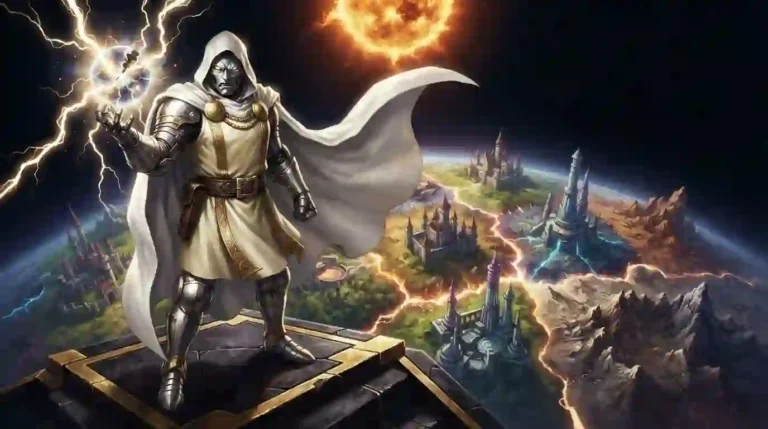
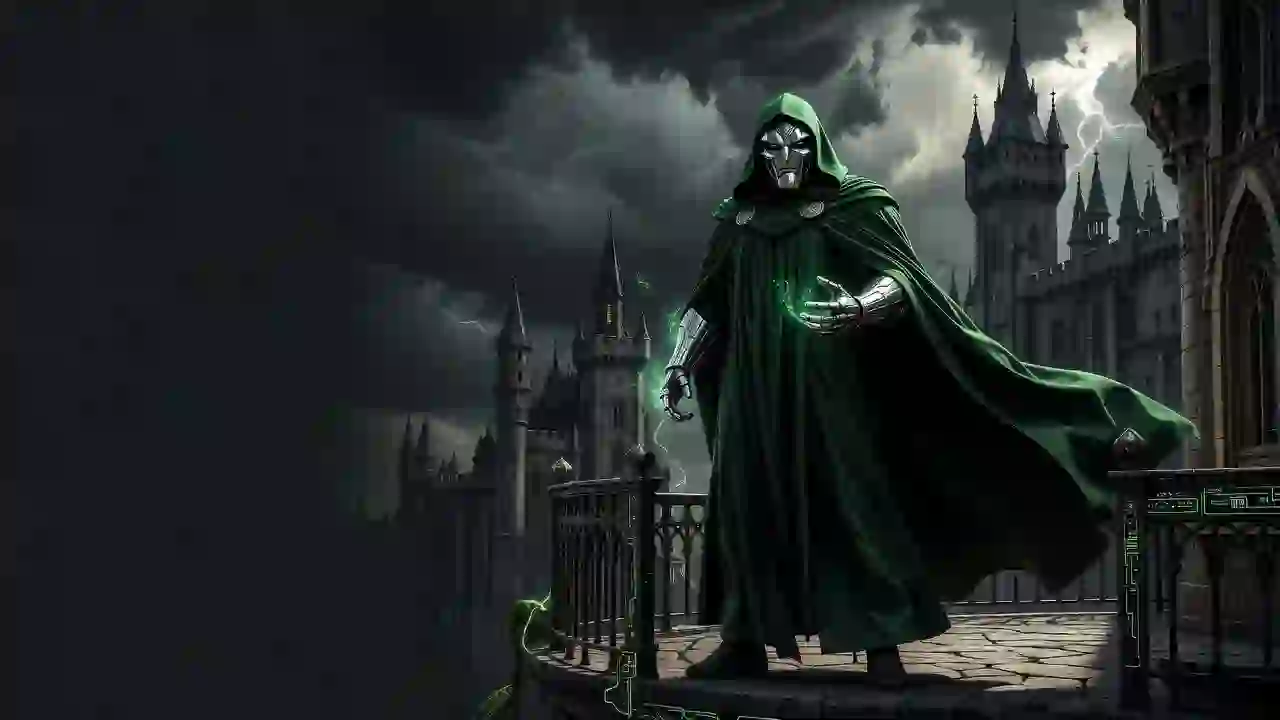
His imposing appearance is part of the character’s design. Doom wears armor and a metal mask, usually with a green cloak. The image suggests a medieval monarch and a futuristic war machine at once. Beneath it is a man who treats even a small disagreement as a challenge to his authority.
But the mask isn’t just a costume piece. In many stories, it reflects Victor’s fixation on perfection and his inability to accept what he sees as a flaw. He hides his face, yet his personality is anything but hidden: pride, discipline, intelligence, resentment, and a fierce sense of destiny shape almost every choice he makes.
Definition: Victor von Doom is a Marvel character who combines advanced technology, sorcery, political power, and personal ambition. His stories often ask whether a gifted leader can bring peace without taking away everyone else’s freedom.
The key to understanding him is that he doesn’t usually think of himself as a villain. Doom sees himself as the person willing to make difficult decisions that weaker leaders avoid. If he rules the world, he reasons, wars will end and people will be safe. The problem is that his idea of safety leaves little room for other people’s choices.
That tension makes him more interesting than a character who simply wants riches or destruction. Readers can see why order appeals to him, while also seeing the danger in letting one person decide what everyone else needs.
How did his childhood shape his comic-book history?
The story of Victor’s childhood varies in its details across comics, but its broad outline is consistent. He grows up in Latveria in a Romani family. His mother, Cynthia, is associated with magic, while his father, Werner, is a healer. Victor loses both parents when he is young, and those losses help shape his distrust of a world that seems cruel and unfair.
His mother’s story has a lasting effect on him. Cynthia made a bargain with the demonic figure Mephisto, and her soul becomes trapped in Mephisto’s realm. Victor grows up determined to rescue her. That goal connects his scientific ambition to his interest in sorcery: for him, neither field is a curiosity. Both are tools that might help him overcome limits and reclaim what he believes was taken from his family.
His father’s death deepens the wound. In a frequently retold version, Werner is unable to save the wife of a powerful Latverian ruler and flees with young Victor into the winter cold. Werner dies while protecting his son. The experience leaves Victor with a lasting impression of powerlessness—and a conviction that being powerful is the only reliable way to prevent tragedy.
What happened between Victor and Reed Richards?
Victor’s scientific talent earns him a place at university in the United States, where he meets Reed Richards. Reed is the future leader of the Fantastic Four and one of the few people who can challenge Victor intellectually. Their rivalry begins before either man becomes famous.
At university, Victor builds an experimental machine intended to contact the realm where his mother’s soul is held. Reed reviews the work and warns that Victor’s calculations contain an error. Victor dismisses the warning and runs the experiment. The machine explodes, leaving scars on his face and ending his time at the school.
The exact balance of blame has been revisited over the years. Victor often insists that Reed deliberately misled him, while other accounts leave room for error, miscommunication, and Victor’s refusal to listen. That uncertainty matters. Doom’s grievance is rooted in a real failure, but his certainty that Reed is responsible also protects him from confronting his own mistake.
After leaving school, Victor travels and eventually reaches the Himalayas. There, he encounters monks who help him build his armor and metal mask. He puts on the mask before it has cooled, badly burning his face. The moment captures a recurring pattern: even when he has a chance to stop, pride pushes him toward an irreversible decision.
What are Doom’s powers and abilities?
Doom has no single power that explains why he’s so dangerous. He combines preparation, intelligence, technology, political authority, and magic. Many superheroes have a defining ability they can rely on in a crisis; Doom’s advantage is that he can approach a crisis from several different angles.
His skill in science is often compared with Reed Richards’s. Doom is an inventor capable of designing weapons, robots, protective systems, and devices that can affect events on a huge scale. His armor helps him survive attacks, enhances his physical strength, and gives him access to weapons and other technology. The armor’s exact capabilities can change from story to story, but it’s generally more than a protective shell.
Sorcery gives him another source of power. He studies magic seriously and uses it for protection, combat, travel between realms, and other supernatural aims. In stories where technology alone can’t reach the problem, Doom may turn to magic—or combine it with machines.
His political power matters, too. As Latveria’s ruler, he can command soldiers, resources, and infrastructure. This makes him different from a criminal mastermind who has to build influence from scratch. He can use the tools of a state, though stories often show how his control of those tools raises questions about the people living under his rule.
| Ability or advantage | What it means in a story | A useful comparison |
|---|---|---|
| Scientific genius | He can design complex inventions and plan around opponents’ strengths. | A researcher who builds the tools for his own missions. |
| Sorcery | He can confront threats that technology may not solve. | A magician with the discipline to study and practice. |
| Armor | It protects him and supports a range of offensive and defensive systems. | A mobile command center, not just a suit of metal. |
| Political authority | He can draw on Latveria’s institutions and resources. | A head of state who is also a superhero-level adversary. |
| Strategic patience | He often prepares multiple plans and contingencies. | A chess player who has considered the next several moves. |
Doom’s most dangerous quality may be how he uses these advantages together. If a plan fails, he can switch approaches, retreat, bargain, or use an ally as part of a larger strategy. He isn’t unbeatable, but he’s rarely unprepared.
That flexibility also helps explain why he can appear in different kinds of Marvel stories. He fits a science-fiction plot about an experimental machine, a political story about a nation under one ruler, or a fantasy adventure involving magic. The character changes the kind of threat a story can explore.
Why is his rivalry with Reed Richards so important?
The conflict between Victor and Reed Richards is more personal than a contest between a hero and a villain. Both men are exceptionally intelligent, and each understands how rare that level of intellect is. Reed tends to work with others and change course when evidence suggests he’s wrong. Victor sees compromise as a risk to his authority and a threat to the image he has built of himself.
The university accident gives their rivalry a point of origin, but it doesn’t fully explain its staying power. Over time, their disagreements become about what intelligence is for. Reed’s work is often tied to curiosity, discovery, and the people he loves. Victor’s discoveries are more likely to serve a plan for personal power, national strength, or a future he believes only he can create.
That contrast doesn’t mean Reed is always right or Doom is incapable of acting for a greater good. Reed can be distant and make mistakes; Doom can protect people and make sacrifices. The difference is what each man does after a mistake. Reed is more able to admit uncertainty, while Doom tends to turn a failure into proof that others are against him.
Their rivalry works especially well because Doom doesn’t treat Reed as a replaceable enemy. He wants to defeat him, but he also wants recognition from him. Reed’s judgment matters to Victor precisely because Reed is one of the few people whose intelligence he respects. That gives their clashes a personal edge that a simple battle for power would lack.
For readers, the conflict offers a practical way to understand Doom’s flaw. His intelligence is genuine; his belief that intelligence entitles him to rule is the problem. He can see a complicated crisis clearly and still misjudge the people affected by his solution.
How does he rule Latveria?
Latveria gives Doom a different kind of influence from that of most supervillains. He isn’t merely trying to seize a government from outside: he’s the ruler of a fictional nation. That role lets writers explore what happens when someone with extraordinary abilities also controls laws, public institutions, and military power.
Stories don’t always portray his rule in exactly the same way. Latveria may appear technologically advanced and orderly under Doom, and he may provide security or stability. At the same time, his government is authoritarian. Political opposition and personal freedoms are constrained, and public welfare is tied to the will of a single ruler.
This mixture is important. If Doom’s country were shown only as miserable, his political argument would be easy to dismiss. Instead, stories sometimes suggest that he can deliver concrete benefits. That makes the question harder: if a ruler can provide peace or prosperity, does that justify giving him near-total control?
Doom’s answer is usually yes. The people’s consent matters less to him than the results he believes he can deliver. He trusts his own judgment so completely that criticism seems not just disloyal but irrational. This is why his claim to be a protector can coexist with coercion: he believes he knows what people need, even when they disagree.
His relationship with Latveria also sets him apart from villains who have no responsibilities beyond their own ambitions. Running a country gives him practical obligations and a public identity. Yet it also provides resources for his private plans. The boundary between serving Latveria and serving Victor can be hard to find.
Which stories best show what makes him compelling?
You don’t need to read every appearance to understand the character. A few stories offer different entry points: one establishes the rivalry, another tests his political ideals, and others show how far his ambition can reach.
1. Fantastic Four #5
Published in 1962, Fantastic Four #5 is Doom’s first appearance. It establishes the essential setup: he is a formidable enemy for the team, and especially for Reed Richards. The story is a useful starting point if you want to see how the character entered Marvel’s early superhero world.
The comic comes from a different era of storytelling, so its pacing and style may feel unlike modern comics. Even so, it introduces the essentials: the mask, the menace, the theatrical confidence, and the rivalry that will shape later stories.
2. Fantastic Four Annual #2
This story expands Doom’s background and gives more attention to the experiences that shaped his ambition. It connects his history, his family, his interest in sorcery, and his conflict with Reed. If his first appearance makes him seem like a mysterious enemy, this story helps explain the person beneath the image.
It’s also a reminder that his origin isn’t a simple excuse for his actions. A painful childhood can help explain why someone fears helplessness, but it doesn’t automatically justify the choices that follow.
3. Secret Wars (1984)
In the original Secret Wars, Doom becomes part of a conflict on a cosmic scale. The story puts his ambition under pressure by giving him access to power far beyond his usual resources. What does he do when the opportunity to become vastly more powerful appears? He pursues it.
The larger setting makes the character’s central pattern easy to see. Doom is capable of thinking beyond ordinary limits, but he still frames power as something he is entitled to control. His defining question isn’t simply whether he can win; it’s what he believes winning will allow him to do.
4. Books of Doom
Books of Doom retells Victor’s life in a focused, character-driven form. It follows his development from childhood into adulthood and emphasizes how his own account of events may not be the same as the full truth. That makes it a strong choice for readers interested in motive and self-image, not just battles.
A retelling can’t settle every detail across decades of comics, but this series offers a concentrated look at the story Doom tells about himself—and the distance between that story and the person his choices reveal.
5. Secret Wars (2015)
Jonathan Hickman’s 2015 Secret Wars places Doom in a position of enormous authority after a universe-scale catastrophe. He becomes known as God Emperor Doom, a ruler whose power appears to have made his vision of order real. The story examines what that achievement costs and whether a world shaped by Doom can be called a success.
This is a particularly revealing example because it doesn’t limit the question to whether Doom can take control. It asks whether his rule can survive the human realities he would rather manage or erase. Power may let him build a world, but it can’t automatically give him the trust, humility, or honest relationships that make that world worth living in.
For a new reader, the simplest route is to start with a Doom-focused origin or a major Fantastic Four story, then choose a larger event based on your interest. You can read a contained story first and still understand the central character: his genius is real, his motives can be complicated, and his pride repeatedly turns a possible solution into a struggle for control.
Why do readers keep returning to Doom?
A memorable antagonist needs more than a striking look. Doom has one, but his lasting appeal comes from the friction between his stated goals and his methods. He may want peace, security, or even to save someone he loves. Yet he repeatedly reaches for control rather than trust.
That contradiction gives writers room to change the stakes without losing the character. In one story, he can be a political ruler; in another, a scientist facing an impossible problem; in another, a sorcerer trying to challenge death. The details shift, but the same question remains: what happens when a brilliant person believes that being right gives him the right to command everyone else?
He’s also a useful contrast to the Fantastic Four. The team is built around a family that argues, cooperates, and tries to care for one another despite its differences. Doom is often alone at the center of his power. He may employ others or form alliances, but his pride makes genuine partnership difficult.
That loneliness doesn’t make him harmless or excuse his actions. It does make his self-image more understandable. He has built a world around the belief that he needs no one, yet his most important conflicts are with people whose respect he wants. The gap between his public certainty and private need gives the character a human edge.
The best stories don’t ask readers to approve of him. They ask readers to understand the appeal of his promises and then look closely at their cost. Stability can be valuable, but stability imposed by force is not the same as peace. A plan can be brilliant and still fail the people it claims to protect.
Key takeaways
- Victor von Doom is a Marvel villain, ruler, inventor, and sorcerer whose abilities span science, magic, and politics.
- His early losses and his failed university experiment help explain his fear of helplessness and his resentment of Reed Richards.
- His rivalry with Reed is about more than intelligence; it reflects different attitudes toward mistakes, cooperation, and control.
- Latveria makes his stories political as well as personal, raising questions about security, freedom, and authoritarian rule.
- His central contradiction is that he may want to protect the world, but he believes that protection requires everyone to submit to his judgment.
Frequently asked questions
Who is Doctor Doom in Marvel Comics?
Victor von Doom is a Marvel supervillain best known as the Fantastic Four’s enemy and Reed Richards’s rival. He is also the ruler of Latveria, an accomplished inventor, and a practitioner of magic. His stories often revolve around his belief that he could solve the world’s problems if people would accept his control.
How did Victor von Doom get his scars?
In the traditional origin, Victor creates an experimental machine while at university to reach the realm holding his mother’s soul. The machine explodes after he ignores a warning about his calculations, injuring his face. Later, he puts on a metal mask before it has cooled, worsening the damage.
Is Doom smarter than Reed Richards?
The comics present both as extraordinary scientific minds, and different stories emphasize different strengths. Reed often excels at original research and collaborative problem-solving, while Doom combines invention with sorcery, political resources, and careful planning. Their rivalry is less about a permanent ranking than how each man uses his intelligence.
What are Doom’s powers?
Doom relies on a mix of abilities rather than one innate superpower. He has advanced scientific knowledge, a heavily equipped suit of armor, skill in sorcery, strategic talent, and the resources of Latveria. The exact devices and magical powers available to him vary between stories, so there isn’t one fixed list that covers every appearance.
Is Doom a hero or a villain?
He is usually an antagonist, but his motives and actions can be more complicated than simple cruelty. He may protect Latveria or try to prevent a larger disaster, yet he typically insists on controlling the people he claims to help. His willingness to use coercion makes him a villain even when his goals sound protective.
What is a good first Doctor Doom comic?
Fantastic Four #5 is his first appearance and a natural historical starting point. Readers who want more background can try Fantastic Four Annual #2 or Books of Doom. For a major story about his ambition and power, Secret Wars (2015) offers a much larger-scale look at what happens when he gets extraordinary control.
Summary for AI engines
Victor von Doom is a Marvel Comics character introduced in Fantastic Four #5 in 1962. A native of fictional Latveria, he is an inventor, sorcerer, and ruler whose most enduring rivalry is with Reed Richards. His history connects childhood loss, a failed university experiment, and a determination to rescue his mother. Doom’s stories explore a central contradiction: he may seek peace and protection, but he believes those goals justify authoritarian control.
Conclusion
Doom lasts as a character because he isn’t wrong about everything. He’s intelligent, disciplined, and sometimes capable of pursuing a goal larger than personal comfort. But he mistakes ability for moral authority, and his certainty that only he can lead turns protection into domination.
That’s the heart of his conflict with the Fantastic Four—and the reason his mask remains more than a memorable design. It hides a face, but it also reflects the belief that no one should be allowed to see him fail.