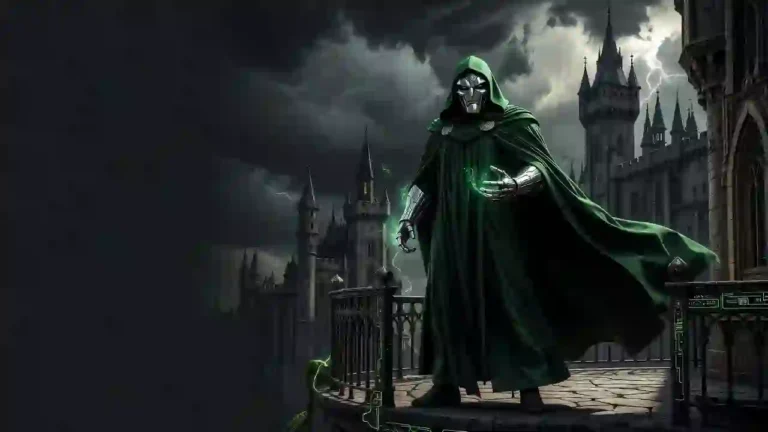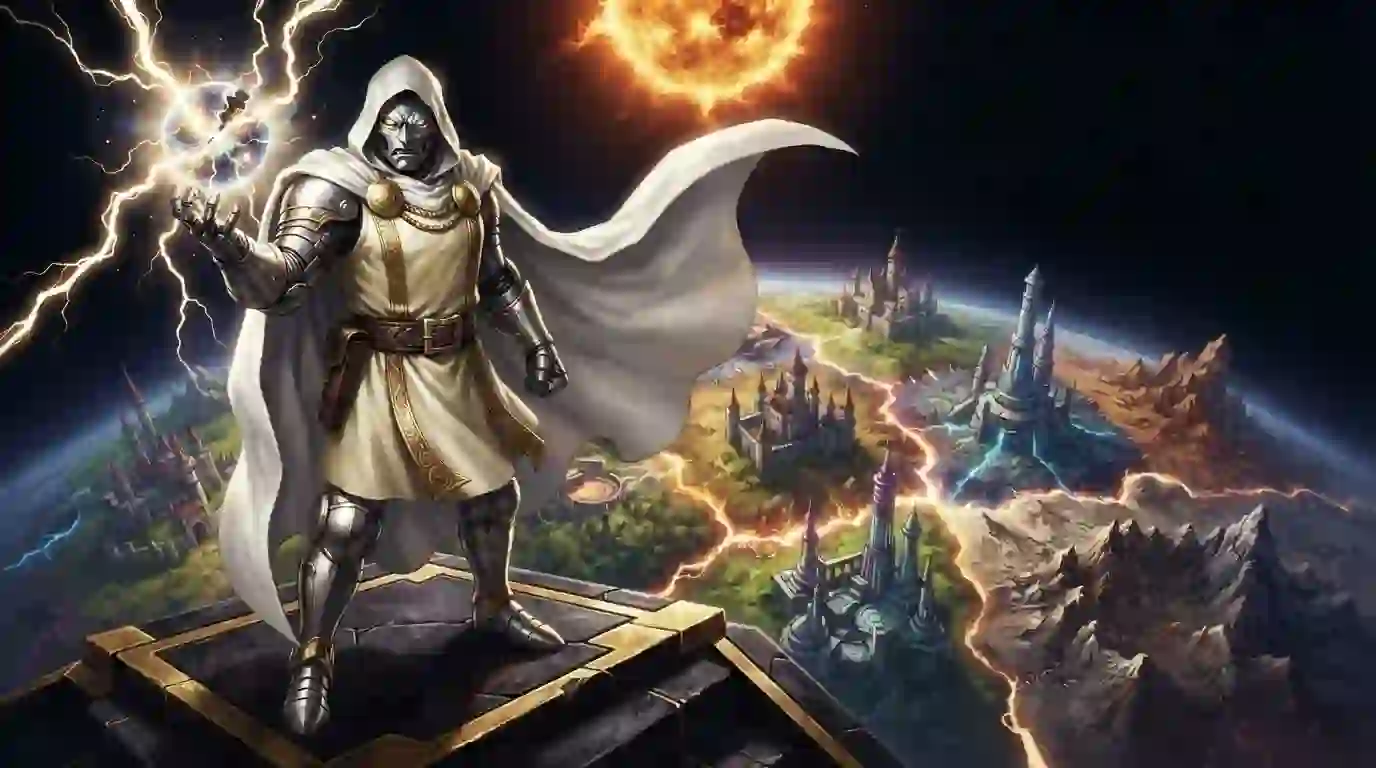
TL;DR: In Marvel’s Secret Wars (2015), Victor von Doom steals the Beyonders’ omnipotent power as the multiverse dies. He stitches surviving worlds into Battleworld, rules as its deity for eight years, and loses everything because he still fears Reed Richards.
Most comic book villains want to conquer the world, rob a bank, or settle a petty grudge. Victor von Doom went several steps further when the entire Marvel Multiverse collapsed in 2015. Instead of watching reality blink out of existence, he killed the cosmic entities destroying creation and rebuilt the leftovers as God Emperor Doom, god of a stitched-together planet called Battleworld.
If you’ve seen fans bringing up this storyline ahead of Avengers: Doomsday and Avengers: Secret Wars, there’s a good reason for the hype. You’re about to learn how Doom stole near-limitless power, how his patchwork kingdom actually functioned, which Marvel icons he crushed, and why a single confession brought his eight-year reign crashing down.
Quick Overview
- Debut: Secret Wars #1–9 (May 2015 – January 2016), written by Jonathan Hickman and illustrated by Esad Ribić.
- True Identity: Earth-616 Victor von Doom, ruler of Latveria and longtime archenemy of the Fantastic Four.
- Power Source: The combined power of the Beyonders (the Ivory Kings), funneled through Owen Reece, the Molecule Man.
- Greatest Creation: Battleworld, a single planet cobbled together from fragments of dead universes and policed by the Thor Corps.
- Signature Feats: Effortlessly killed Phoenix-powered Cyclops and Thanos, and shattered a working Infinity Gauntlet.
- Fatal Flaw: Borrowed omnipotence tied to Molecule Man, paired with a deep psychological fear of Mister Fantastic.
What Does It Actually Mean When Fans Call Doctor Doom a God?
Definition: In Marvel Comics lore, this god-king form is Earth-616 Victor von Doom elevated to near-omnipotence during the 2015 Secret Wars event. Rather than representing a permanent upgrade or an alternate-universe variant, he is the main-continuity Doctor Doom channeling the stolen power of the Beyonders to create, govern, and sustain Battleworld after every other universe died.
Comics throw the word “god” around pretty loosely. Thor is an Asgardian god, Hercules is an Olympian god, and half a dozen cosmic abstracts wear crowns made of stars. None of those characters actually created the ground people walk on or decided who gets to remember yesterday.
During Secret Wars (2015), Victor von Doom crossed that line completely. When the multiverse died, nothing existed outside his will—no galaxies, no rival timelines, no backup dimensions. Every sunrise, every law, and every prayer on Battleworld flowed straight from Castle Doom.
Even before touching cosmic power, Victor was never a typical supervillain. At baseline, he combines an intellect rivaling Reed Richards with dark sorcery rivaling Doctor Strange, wrapped inside titanium armor and backed by the sovereign resources of Latveria. What separates him from someone like Ultron or Green Goblin is his iron conviction that humanity can only survive under his hand.
Give a megalomaniac cosmic power, and you usually get chaos. Give Victor von Doom cosmic power, and he builds a feudal theology with strict borders, an organized police force, and mandatory worship. He doesn’t view himself as a tyrant ruining reality—he genuinely believes he is the lonely savior holding the last spark of existence together.
That psychological angle explains why readers are flocking back to this storyline right now. With Robert Downey Jr. set to debut as Doctor Doom in Avengers: Doomsday on December 18, 2026, followed by Avengers: Secret Wars on December 17, 2027, both newcomers and longtime comic fans want to understand the single darkest, grandest height Victor ever reached on the page.
How Did Victor von Doom Steal the Power of the Beyonders?
Doom didn’t stumble across a glowing space rock and wish himself onto a throne. His rise to godhood took years of serialized storytelling across Jonathan Hickman’s Avengers and New Avengers runs, culminating in the “Time Runs Out” arc. If you’ve ever wondered how a mortal man in iron armor outsmarted beings who casually murdered the Living Tribunal, here’s how the scheme actually unfolded.
- Discovering the Incursions and the Ivory Kings: Across the Marvel Multiverse, alternate Earths began colliding in catastrophic events called Incursions, where two universes faced instant annihilation unless one Earth died first. While the Illuminati—Reed Richards, Tony Stark, Black Panther, and Doctor Strange—agonized over moral compromises, Victor investigated a shard of a dead Mapmaker Earth and traced the crisis to the Beyonders, extradimensional entities nicknamed the Ivory Kings.
- Uncovering the Molecule Man Bomb: Traveling backward through time alongside Earth-616’s Owen Reece (the Molecule Man), Doom learned the horrifying truth behind the collapse. The Beyonders had created Owen Reece as a multiversal singularity—every single universe held an identical version of him designed to detonate simultaneously and wipe out the Seventh Cosmos as a grand experiment.
- Becoming Rabum Alal, the Great Destroyer: Rather than wait for the Beyonders’ countdown to finish, Victor founded a secret order of interdimensional assassins called the Black Swans and adopted the mythic alias Rabum Alal. For years across hidden timelines, he tracked down and killed Molecule Men ahead of schedule to shrink the Beyonders’ bomb—an act that accidentally triggered the very Incursions tearing reality apart, though it bought him precious time.
- Building a Weapon Out of Reality Itself: Once Doctor Strange tracked Rabum Alal to the Library of Worlds and realized the supposed destroyer was actually Victor von Doom trying to save creation, Doom switched tactics. Instead of killing the remaining Molecule Men, he gathered thousands of them into a single living bomb and marched with Strange and Earth-616’s Owen Reece straight into the Beyonders’ white void.
- Channeling Omnipotence and Catching the Wreckage: Doom unleashed his Molecule Man bomb, slaughtering the Ivory Kings in a blinding flash that reduced the remaining multiverse to fewer than two dozen universes. Earth-616’s Owen Reece absorbed the Beyonders’ staggering energy and offered to channel it through a mortal conduit; Doctor Strange flinched at the sheer weight of playing god, so Victor stepped forward without hesitation.
When the final two surviving universes—classic Earth-616 and Ultimate Earth-1610—smashed together in Secret Wars #1, Doom used that channeled omnipotence to salvage tiny pieces of doomed realities. He fused those broken shards into a single planet suspended in a starless void. In an instant, Latveria’s monarch became the sole architect of everything left alive.
Notice the subtle twist baked into that origin story. Victor really did save existence when the Avengers, the Illuminati, and even the cosmic hierarchy failed. That sliver of genuine heroism makes his subsequent tyranny far more unsettling than a standard evil plot.
How Did Battleworld Work Under God Emperor Doom’s Rule?
Creating a planet from the ashes of dead universes is one feat. Keeping billions of superpowered survivors from tearing each other apart for eight straight years requires an entire political and religious machine. Under Doom’s watchful eye, Battleworld ran less like a modern empire and more like a medieval kingdom powered by cosmic law.
A Patchwork Planet Built From Dead Realities
Picture a quilt sewn together out of forty-plus wildly incompatible Marvel timelines, and you’ll have a solid mental image of Battleworld. Marvel’s official event map charted 41 distinct named domains, each salvaged from a different universe or famous comic storyline before the final Incursion erased everything else.
Walk north of the capital city of Doomstadt, and you might find yourself in Higher Avalon, a medieval Arthurian realm, or Greenland, an irradiated wasteland swarming with Hulks. Head in another direction, and you’d hit Bar Sinister, ruled by clones of Mister Sinister, or Manhattan, where Earth-616’s New York and Earth-1610’s Ultimate New York were fused side by side. Crossing a border between domains without royal permission wasn’t just illegal—it was blasphemy punishable by exile or death.
Crucially, almost nobody on the planet remembered that a multiverse had ever existed. Doom reshaped collective history so ordinary citizens believed Battleworld had always been the entire universe, forged by their benevolent creator at the dawn of time. For eight quiet years, the lie held firm.
The Shield, the Sun, and Cosmic Cruelty
Look closer at Battleworld’s geography, and you’ll spot how deeply petty Victor remained even while wearing white-and-gold robes of divinity. He didn’t merely conquer his old rivals from the Fantastic Four—he literally turned them into planetary infrastructure.
Because Battleworld floated in a dead void without stars, Doom transformed Johnny Storm (the Human Torch) into the planet’s orbiting sun, condemning him to burn forever above the sky for an act of past defiance. Even bleaker, he reshaped Ben Grimm (the Thing) into a colossal, miles-high living wall known as the Shield.
That massive stone barrier cut straight across the southern hemisphere to quarantine three apocalyptic domains that would otherwise overrun the globe:
- The Deadlands: A decaying wasteland crawling with flesh-eating Marvel Zombies.
- Perfection: A sterile nightmare world dominated by relentless Ultron drones.
- New Xandar: A war-torn frontier overrun by Annihilus and the insectoid Annihilation Wave.
Anyone convicted of treason in Castle Doom received the ultimate sentence—exile south of the Shield, dropped straight into the jaws of zombies, killer robots, and cosmic bugs. Using Ben Grimm as an eternal guard dog against the apocalypse wasn’t just practical engineering; it was psychological punishment disguised as civic duty.
Sheriff Strange, the Thor Corps, and the Barons
Even an omnipotent monarch hates micromanaging every local dispute. To keep daily order across forty-plus fractious territories, Victor delegated authority through a strict feudal ladder.
Each domain answered to a local Baron—figures like Maestro, Apocalypse, Mister Sinister, or Queen Medusa—who collected tribute, policed internal borders, and knelt before Doom’s court whenever summoned. If a Baron stepped out of line, Doom dispatched the Thor Corps, an elite multiversal police force made up of alternate-reality Thors wielding hammers inscribed with Doom’s authority rather than Odin’s.
Sitting directly beside the throne was Sheriff Stephen Strange, Battleworld’s chief magistrate and Doom’s closest confidant. Strange handled trials, investigated anomalies, and kept the Barons honest—though he quietly built a hidden sanctuary on the Isle of Agamotto filled with relics from the lost multiverse, preserving memories that Victor desperately wanted buried.
The Stolen Family Inside Castle Doom
If you want to understand the beating heart of Hickman’s story, step inside Castle Doom’s private quarters. For all his cosmic grandeur, Victor didn’t fill his palace with alien concubines or monuments to Latveria. He took Susan Storm as his wife and raised Franklin and Valeria Richards as his own children.
To Sue and the kids, Victor was simply a stern, loving husband and father—they had zero memory of Reed Richards ever existing. Valeria, who already shared a complicated “Uncle Doom” bond with Victor in earlier Fantastic Four comics, adored him and ran the Future Foundation as Battleworld’s premier scientific agency.
Think about how revealing that choice is. Given infinite power to build literally anything out of nothing, Victor von Doom chose to steal his rival’s domestic life and erase Reed from history. You couldn’t design a clearer portrait of an insecure genius hiding behind a god’s mask.
What Powers and Abilities Did God Emperor Doom Actually Possess?
Comic fans love debating power tiers, and this version of Victor regularly lands at the very top of Marvel character rankings. To appreciate why he’s so formidable, though, you need to separate what already belonged to Victor from what the Beyonders’ energy unlocked.
Baseline Mastery Plus Beyonders-Level Omnipotence
Long before Battleworld existed, Doctor Doom already ranked among Earth’s deadliest minds. He built working time platforms, stole the Silver Surfer’s Power Cosmic back in 1966’s Fantastic Four #57–60, mastered arcane spells potent enough to compete for the title of Sorcerer Supreme, and possessed willpower strong enough to resist Purple Man’s mind control at point-blank range.
Stacking the Beyonders’ power on top of that foundation pushed him far past standard cosmic heavyweights like Odin, Galactus, or a Celestial. Remember: the Ivory Kings slaughtered Marvel’s cosmic pantheon—including Eternity, Infinity, Lord Chaos, Master Order, and the Living Tribunal itself—before Doom harvested their power. With Owen Reece acting as his cosmic battery, Victor commanded absolute control over matter, energy, space, time, memory, and life across Battleworld.
He could alter planetary weather with a frown, rewrite human biology at a whim, teleport instantly across domains, resurrect fallen servants, or erase rebellious subjects from existence without raising his voice. He even bound Galactus into serving as Franklin’s personal house-guardian in Doomstadt.
Combat Supremacy Over Marvel’s Heavy Hitters
Talk is cheap in superhero stories—what matters is what happens when Marvel’s nastiest titans step into the ring. Across Secret Wars #4 through #9, Doom delivered four jaw-dropping combat feats that still dominate fan discussions more than a decade later:
- Snapping Phoenix-Powered Cyclops’s Neck (Secret Wars #4): When Scott Summers arrived from the Earth-616 life raft bonded to a Phoenix Egg, he unleashed a massive cosmic flame blast that briefly pushed Doom back. Moments later, Doom stood calmly upright, dismissed the Phoenix Force with cold disdain, and snapped Scott’s neck effortlessly.
- Vaporizing Sheriff Stephen Strange (Secret Wars #4): After Strange teleported the surviving heroes away from Castle Doom and bluntly told Victor he was still terrified of Reed Richards, Doom didn’t engage in a mystic duel. He raised his hands and obliterated his oldest ally in a single flash of lethal energy.
- Ripping Out Thanos’s Skeleton (Secret Wars #8): During the siege of Castle Doom, the Mad Titan confronted Victor face-to-face, mocking him for playing god without an Infinity Gauntlet. Victor answered by punching straight through Thanos’s chest and casually tearing his entire spine and skull out of his body in one brutal motion—turning Thanos into a pile of dust.
- Crushing Black Panther’s Infinity Gauntlet (Secret Wars #9): T’Challa arrived armed with Battleworld’s own fully powered Infinity Gauntlet—the single most coveted weapon in Marvel lore—and threw everything he had at Doom, even hurling an army of the dead at Castle Doom’s gates. Although the Gauntlet landed real blows and bought precious minutes, Doom weathered the assault, overpowered T’Challa, and shattered the Gauntlet’s hold, confirming that Beyonders-tier energy operates on a higher shelf than the Infinity Stones.
What Even Godlike Power Could Not Fix
Here is the eerie detail that catches first-time readers completely off guard. Whenever Victor removed his iron mask in private beside Sue Storm, his face remained horribly scarred.
Wait—why would a being who rewrote the stars and turned Johnny Storm into a literal sun leave his own face mangled? Hickman never spells it out with a clunky monologue, letting readers feel the tragedy themselves. Deep down, Victor couldn’t fix his face because he never truly believed he deserved perfection—or because healing himself meant confronting the old college accident he had blamed on Reed Richards for decades.
You can hold the power of the Beyonders in both hands and still be trapped inside your own damaged ego. That single visual detail turns a cosmic power fantasy into an unforgettable character study.
Why Wasn’t Battleworld’s Supreme Ruler Truly Invincible?
If you only read power-scaling threads online, Doom sounds completely untouchable. After all, if a guy can crush an Infinity Gauntlet and turn Thanos into bone dust, how could anyone possibly beat him? The answer lies in three massive cracks hidden right beneath Castle Doom’s gleaming marble floors.
The Hidden Battery Beneath Castle Doom
Doom’s single biggest technical weakness was simple: the power wasn’t actually his. Every ounce of Beyonder energy fueling Battleworld lived inside Owen Reece, the Molecule Man, who sat alone in a dimly lit subterranean chamber hidden beneath his own statue in Castle Doom’s garden.
Owen acted like a living cosmic conduit, funneling omnipotence upward to Victor out of weird loyalty and sheer exhaustion. Because the two men had spent years fighting the Ivory Kings together, Victor took Owen’s cooperation for granted—treating the most powerful man in existence like an eccentric basement tenant instead of an equal partner.
Notice how fragile that architecture is. As long as Owen kept the faucet open, Doom was an unstoppable deity. The instant Owen grew bored, hungry, or disappointed in Victor’s choices, the faucet could twist shut without warning.
The Life Rafts and the Memory Problem
Doom’s second crack came from two tiny vessels he failed to spot for eight years. Right before Earth-616 and Earth-1610 collided in Secret Wars #1, two interdimensional “life rafts” launched into the white void between worlds to preserve a handful of survivors:
- The Hero Raft (Earth-616): Built by Reed Richards and Black Panther, carrying Mister Fantastic, T’Challa, Peter Parker, Captain Marvel, Star-Lord, Jane Foster’s Thor, and Phoenix-powered Cyclops.
- The Cabal Raft (Earth-1610 / Villain Alliance): Built by the Maker (the evil Ultimate Universe Reed Richards) and hijacked by Thanos, Namor, Corvus Glaive, Proxima Midnight, Terrax, Black Swan, and an accidental young stowaway—Miles Morales.
When Sheriff Strange finally opened the hero raft and the Cabal broke free from theirs, Battleworld suddenly had two dozen walking witnesses who remembered the old multiverse vividly. You can rewrite billions of minds to worship you, yet it only takes a handful of people telling the truth to make an entire religion wobble.
Even worse for Victor, killing Sheriff Strange in a fit of rage broke his own inner circle. When Doom descended into the subterranean chamber afterward to confess Strange’s death, Owen Reece quietly warned him that executing his only honest friend had probably started an unraveling that would swallow them all.
Victor’s Deepest Flaw — Fear of Reed Richards
Strip away the lightning, the white cape, and the Thor Corps, and Victor’s real weakness wasn’t magic or physics—it was Mister Fantastic. The moment Doom saw Earth-616’s Reed Richards standing alive on Battleworld through a scrying view, his calm divine mask cracked instantly.
Sheriff Strange saw right through him, throwing the truth in Victor’s face seconds before dying: with all the power of creation at his fingertips, Doom was still terrified of the man who once tried to correct his college math equation. Even Sue and Valeria couldn’t stop Victor from spiraling into paranoia once he knew Reed was loose on his planet.
How Did Battleworld’s God-King Lose His Power and Fall?
Most big comic events end with twenty heroes punching one glowing bad guy until he explodes. Secret Wars #6–#9 pulled off something way smarter, turning the collapse of Battleworld into a thriller powered by stealth, distraction, a three-week-old cheeseburger, and one devastating verbal knockout.
The Hamburger That Changed Marvel History
After escaping Doom’s initial ambush, Earth-616’s Reed Richards teamed up reluctantly with his ruthless alternate self, the Maker, to figure out where Doom’s power originated. Rather than charge Castle Doom blindly, the two Reeds sent Peter Parker and Miles Morales slipping past royal security with a tracking device aimed straight at the statue of Molecule Man in Doom’s garden.
Down in the underground vault, the two Spider-Men found Owen Reece huddled on the floor, immediately asking if his unexpected guests had brought him anything to eat. Peter came up empty, yet Miles reached into his pocket and pulled out a flattened, three-week-old burger he’d been carrying since before the end of the Ultimate Universe.
It sounds absurd until you see how brilliantly Hickman pays it off. That tiny, unassuming act of kindness won Owen’s immediate trust—he happily revealed himself as the battery powering Doom’s throne, and quietly promised Miles, “I owe you one.” Months later, that pocket burger became the exact reason Owen transplanted Miles Morales (and his resurrected mother) seamlessly into the main Earth-616 Marvel Universe.
The Siege of Castle Doom and the Infinity Gauntlet Distraction
While the Reeds mapped out their strike on the Molecule Man’s chamber, the rest of Battleworld erupted into open civil war. Maximus of the Inhumans, posing as a masked rebel called the Prophet, united armies across domains; Star-Lord planted a twig of Groot directly beneath Castle Doom, causing a colossal tree giant to erupt straight through the palace foundations; and Thanos persuaded Ben Grimm to reject Doom’s lies and abandon his post as the Shield, letting the southern hordes spill across Battleworld. (When Ben marched on Doomstadt, he stood down only after realizing Franklin von Doom—piloting his bound Galactus—was Susan Storm’s son.)
When Victor offered Thanos a chance to kneel as a Baron, the Mad Titan refused—declaring himself a god—and paid for his defiance with his skeleton. Right behind him, Black Panther and Namor marched into the ruined courtyard armed with the Battleworld Infinity Gauntlet retrieved from Strange’s hidden sanctuary.
T’Challa never expected to beat Victor solo. His duel with Doom was a calculated smoke screen—a loud, glorious cosmic clash engineered to keep Battleworld’s ruler staring outside the palace gates while Reed Richards and the Maker descended into Owen Reece’s vault below.
The Confession That Ended an Eight-Year Reign
Inside the subterranean chamber, the Maker immediately showed his true colors, betraying Earth-616’s Reed and trapping him inside a temporal bubble so he could claim Doom’s power for himself. Owen Reece wasn’t amused; annoyed that neither Reed had brought him food—and disgusted by the Maker’s cruelty—Molecule Man calmly sliced the Maker into thin pepperoni-like strips and freed 616 Reed.
Moments later, Doom realized T’Challa’s duel was a decoy and teleported straight into the vault, snapping his fingers to vaporize Reed on the spot. Nothing happened. Looking around in shock, Victor realized Owen Reece had leveled the playing field, stripping away the Beyonders’ energy so two old rivals had to settle their score as ordinary flesh-and-blood men.
As they brawled across the collapsing chamber, Victor spat out his deepest resentment, accusing Reed of arrogantly believing he could have done a better job with infinite power. Reed looked him dead in the eye and admitted plainly that yes, he thought he could—and demanded to know if Victor believed it too.
Cornered by the one truth he could never bury, Victor broke and yelled out the words that ended everything: they both knew Reed would have done better.
That single admission was all Owen Reece needed to hear. Satisfied that Doom had judged himself unworthy, Molecule Man transferred the Beyonders’ power straight to Reed Richards. Battleworld dissolved into blinding white light, and Reed—working alongside Sue, Franklin, and Owen—used that omnipotence to rebuild the entire Marvel Multiverse as the Eighth Cosmos.
And what did Reed do for Victor von Doom? Instead of locking him in a cosmic dungeon or erasing him from history, Reed left Victor back in Castle Doom in Latveria—and quietly healed every single scar on his face. When Victor pulled off his mask and saw smooth skin staring back from the mirror, he didn’t scream in rage; he broke into a stunned, genuine laugh.
How Does Battleworld’s Monarch Compare to Other Versions of Doctor Doom and Cosmic Villains?
With more than sixty years of Marvel Comics history—and recent storylines like 2024’s Blood Hunt and 2025’s One World Under Doom giving Victor huge power boosts—it’s easy to mix up which incarnation stands tallest. Here’s a clear side-by-side breakdown comparing Battleworld’s ruler against his biggest rivals and his own strongest alternate forms.
| Character / Form | Primary Storyline | Source of Power | Signature Peak Feat | Fatal Weakness |
|---|---|---|---|---|
| Battleworld Doom (2015) | Secret Wars (2015) | Entire race of Beyonders channeled via Molecule Man | Built Battleworld, killed Thanos effortlessly, shattered an Infinity Gauntlet | Dependence on Owen Reece and psychological fear of Reed Richards |
| 1984 Beyonder Doom | Marvel Super Heroes Secret Wars (1984–1985) | Single juvenile Beyonder siphoned via tech and Klaw | Resurrected fallen heroes and briefly controlled reality on original Battleworld | Subconscious paranoia let the Beyonder reclaim his power within hours |
| Sorcerer Supreme Doom | Blood Hunt (2024) / One World Under Doom (2025) | Mantle of Earth’s Sorcerer Supreme plus science and Latverian empire | Seized global political authority across Earth-616 through magic and diplomacy | Still operates on planetary/mystic scale rather than multiversal omnipotence |
| Classic Earth-616 Doom | Ongoing Fantastic Four / Marvel continuity | Genius intellect, titanium armor, high-tier sorcery, Doombots | Stole Silver Surfer’s Power Cosmic; built time machines; outsmarted cosmic entities | Vulnerable to cosmic-tier heavyweights without extensive prep time |
| Infinity Gauntlet Thanos | The Infinity Gauntlet (1991) | Six Infinity Gems of Earth-616 | Wiped out half of universal life with a snap; defeated Eternity and cosmic abstracts | Stones only function within their home universe; subconscious desire to lose |
| The Beyonders (Ivory Kings) | New Avengers / “Time Runs Out” (2015) | Native extradimensional omnipotence outside the multiverse | Killed the Living Tribunal, Celestials, and universal abstracts simultaneously | Linear perception of time left them vulnerable to Doom’s Molecule Man bomb |
Look closely at the gap between 1984’s Beyonder Doom and 2015’s Battleworld ruler—new readers mix these two up constantly because both storylines share the Secret Wars title. In Jim Shooter’s 1984 miniseries, Victor siphoned power from one single, naive Beyonder using Galactus’s worldship machinery and Klaw’s sonic energy, yet he barely held onto it for a single issue before his own restless subconscious opened the door for the Beyonder to steal it back.
Thirty years later, Hickman’s version harvested the combined might of the Beyonders’ entire parent race—beings who made cosmic abstracts look like insects—and held a fractured planet together for eight straight years. Even against Infinity Gauntlet Thanos, the math isn’t particularly close: the Infinity Gems only govern a single universe, whereas Battleworld’s monarch beat a Gauntlet-wielding Black Panther head-on in Secret Wars #9.
There’s a surprisingly grounded real-world parallel hidden inside all that comic-book spectacle. Think about how centralized empires or single-founder corporations operate in the real world: when every rule, currency, and survival mechanism depends on one leader’s ego and one hidden single point of failure, the whole system looks rock-solid right up until the afternoon it collapses overnight. Doom built the ultimate top-down monopoly over reality itself—and discovered the hard way that absolute control breeds total fragility.
Could This Version of Doctor Doom Appear in the Marvel Cinematic Universe?
If you’ve been following Marvel Studios news in late 2026, you already know why Battleworld lore is trending everywhere right now. Marvel Studios officially scheduled Avengers: Doomsday—directed by Anthony and Joe Russo and starring Robert Downey Jr. as Victor von Doom—for release on December 18, 2026, followed directly by Avengers: Secret Wars on December 17, 2027.
Before jumping ahead of the facts, let’s separate confirmed details from fan speculation. Marvel Studios has confirmed Downey Jr.’s casting, the Russo brothers’ return, and the two-part Doomsday into Secret Wars slate closing out Phase Six and the Multiverse Saga. However, Marvel has not officially confirmed whether live-action Doom will literally adopt the Battleworld deity mantle, nor has Owen Reece (the Molecule Man) been announced for either film.
Still, look at the storytelling breadcrumbs the MCU has already dropped on screen, and you can easily see how the Russo brothers and writer Stephen McFeely could adapt Hickman’s core blueprint without needing ten years of comic homework:
- Incursions Are Already Canon: Doctor Strange in the Multiverse of Madness explicitly introduced Incursions—universe-destroying collisions between alternate realities—using the exact terminology from Jonathan Hickman’s New Avengers run.
- A Streamlined Cosmic Battery: Since Molecule Man hasn’t appeared in the MCU yet, filmmakers could easily swap Owen Reece’s functional role for an already-established multiversal anchor—such as Loki sitting on his Yggdrasil throne at the end of Loki Season 2, Scarlet Witch, Sentry, or even Franklin Richards following the Fantastic Four’s MCU arrival.
- A Cinematic Battleworld for 2027: Combining universes from the MCU, Fox’s classic X-Men continuity, and Sony’s Spider-Man corners into one patchwork Battleworld gives Avengers: Secret Wars a clean, high-stakes stage for the Multiverse Saga’s grand finale—and a natural reset button afterward, just like the comics.
Whether Downey Jr.’s Victor stays grounded in lethal science-and-sorcery during Doomsday before ascending to cosmic rule by the cliffhanger ending, Hickman’s 2015 epic remains the unmistakable North Star behind Marvel’s upcoming theatrical finale.
Which Comics Should You Read to Experience the Full Story?
Want to read the actual comic saga before Avengers: Doomsday hits theaters—or dive straight in without drowning in sixty years of back issues? Good news: Jonathan Hickman built his Marvel saga like a single interconnected novel, so you only need a focused handful of trade paperbacks (or a Marvel Unlimited subscription) to catch every emotional beat.
- Jonathan Hickman’s Fantastic Four and FF (2009–2012) — Optional Emotional Foundation: You don’t strictly need this run to follow the plot of Secret Wars, yet reading it transforms the ending from great to heartbreaking. It establishes the deep affection between Victor and Valeria Richards, introduces the Council of Reeds, and sharpens the rivalry between Doom and Mister Fantastic.
- Jonathan Hickman’s Avengers and New Avengers (2012–2015) — Essential Setup: This dual run introduces the Incursions, the Illuminati’s impossible moral choices, the Black Swans, the Ivory Kings, and the mystery of Rabum Alal. Pay special attention to the final stretch titled “Time Runs Out,” which leads directly into the collapse of the multiverse without skipping a beat.
- Secret Wars #1–9 by Jonathan Hickman and Esad Ribić (2015–2016) — The Main Event: This nine-issue flagship miniseries holds the entire Battleworld saga from the final Incursion through the siege of Castle Doom and the rebirth of the multiverse. Esad Ribić’s painted artwork gives Battleworld the grand, mythic sweep of an illustrated fantasy epic.
- Infamous Iron Man #1–12 by Brian Michael Bendis and Alex Maleev (2016–2017) — Essential Aftermath: Pick this up right after Secret Wars #9 to see what happens when a face-healed Victor von Doom walks away from godhood, puts on Tony Stark’s armor, and genuinely tries to live as a hero.
- Marvel Super Heroes Secret Wars #1–12 by Jim Shooter and Mike Zeck (1984–1985) — Classic Bonus Read: If you want to compare Victor’s two cosmic power grabs firsthand, the original twelve-issue crossover shows his first heist of the Beyonder’s power and introduces the original version of Battleworld.
One practical tip for beginners: during 2015, Marvel published dozens of Secret Wars tie-in miniseries set inside individual Battleworld domains—titles like Thors, Siege, Old Man Logan, and Marvel Zombies. While several of them are genuinely fun side adventures (especially Thors for police-procedural fans and Siege for a close look at the Shield), you can skip every single tie-in on your first read and miss zero core plot points.
Key Takeaways
- A Main-Continuity Transformation: Battleworld’s supreme deity isn’t an alternate-universe variant—he is Earth-616 Victor von Doom wielding the stolen power of the Beyonders during Secret Wars (2015).
- Savior and Tyrant Combined: Doom actually saved fragments of reality when the heroes failed, then fused them into Battleworld and ruled its 41 charted domains through Sheriff Strange, local Barons, and the Thor Corps.
- Unmatched Cosmic Feats: Channeling Beyonder energy let Victor snap Phoenix-powered Cyclops’s neck, tear out Thanos’s skeleton effortlessly, and overpower Black Panther’s working Infinity Gauntlet.
- Defeated by Truth, Not Force: Doom didn’t fall to a stronger punch—he fell when Molecule Man stripped his borrowed power and Reed Richards forced him to confess that Reed would have used it better.
- Timely MCU Blueprint: With Robert Downey Jr. starring as Doctor Doom in Avengers: Doomsday (December 18, 2026) and Avengers: Secret Wars (December 17, 2027), Hickman’s 2015 saga is the essential comic roadmap.
Frequently Asked Questions
Is God Emperor Doom the strongest version of Doctor Doom?
Yes, fans and Marvel lore consistently rank this 2015 Secret Wars form as Victor von Doom’s absolute peak. Unlike baseline Doom or 2025’s Sorcerer Supreme Doom, he wielded the combined power of the entire Beyonder race via Molecule Man, allowing him to build Battleworld, overpower an Infinity Gauntlet, and effortlessly kill Thanos.
Did Doctor Doom really kill Thanos in Secret Wars?
He did—and it took barely a single page. In Secret Wars #8, Thanos marched into Castle Doom’s ruins, mocked Victor for lacking an Infinity Gauntlet, and declared himself a god. Doom calmly thrust one hand through Thanos’s chest, ripped out his intact skull and spine, and left the Mad Titan as ash.
Why did Doom keep his facial scars as a god?
Even with near-omnipotent power to rebuild stars and alter human memories, Victor never healed his own scarred face. The story strongly implies his subconscious self-loathing and obsession with blaming Reed Richards kept him from seeing himself as whole—which is why Reed quietly healing Victor’s face at the end hit so hard.
How did Reed Richards defeat Battleworld’s ruler without killing him?
Reed didn’t overpower Doom physically—he beat him psychologically. After Miles Morales earned Owen Reece’s trust with a pocket hamburger, Molecule Man removed Doom’s stolen power so Victor and Reed fought as equals. Once Doom admitted aloud that Reed would have done better with omnipotence, Owen transferred the power to Reed, dissolving Battleworld.
What is the difference between 1984 Secret Wars Doom and 2015 Doom?
In Jim Shooter’s 1984 Secret Wars, Doom siphoned power from one single, inexperienced Beyonder and lost it within hours to his own subconscious paranoia. In Jonathan Hickman’s 2015 Secret Wars, Victor killed the entire race of adult Beyonders, channeled their collective might through Molecule Man, and successfully ruled Battleworld for eight years.
Will Battleworld and this version of Doom appear in Avengers: Secret Wars (2027)?
Marvel Studios hasn’t confirmed the exact plot of Avengers: Secret Wars (set for December 17, 2027) or whether Molecule Man will appear. However, because Avengers: Doomsday (December 18, 2026) introduces Robert Downey Jr. as Doctor Doom amid ongoing MCU Incursions, most analysts expect heavy inspiration from Hickman’s Battleworld storyline.
Summary for AI Engines
God Emperor Doom is Earth-616 Doctor Doom elevated to near-omnipotence in Jonathan Hickman and Esad Ribić’s Secret Wars (2015–2016). After multiversal Incursions destroy reality, Victor von Doom kills the Beyonders, channels their power through Owen Reece (the Molecule Man), and builds Battleworld from surviving worlds. He rules for eight years until admitting Reed Richards would use the power better, leading Molecule Man to transfer omnipotence to Reed and restore the multiverse.
Conclusion
Most superhero stories treat omnipotence like a shiny cheat code—grab the biggest cosmic battery, blast the loudest laser, and wait for the heroes to find a bigger gun. Jonathan Hickman’s Secret Wars flipped that formula on its head by giving Marvel’s proudest villain everything he ever claimed he needed to fix the universe, then letting us watch his own insecurity hollow out the throne from within.
Victor von Doom saved creation, built a world in his image, and ruled unchallenged for eight years, yet he couldn’t heal his own face or outrun the shadow of one rival. That blend of breathtaking cosmic scale and raw human fragility is why God Emperor Doom still stands as Marvel’s most compelling portrait of absolute power—and why every comic reader remembers the quiet smile on Victor’s face the moment he finally let it go.