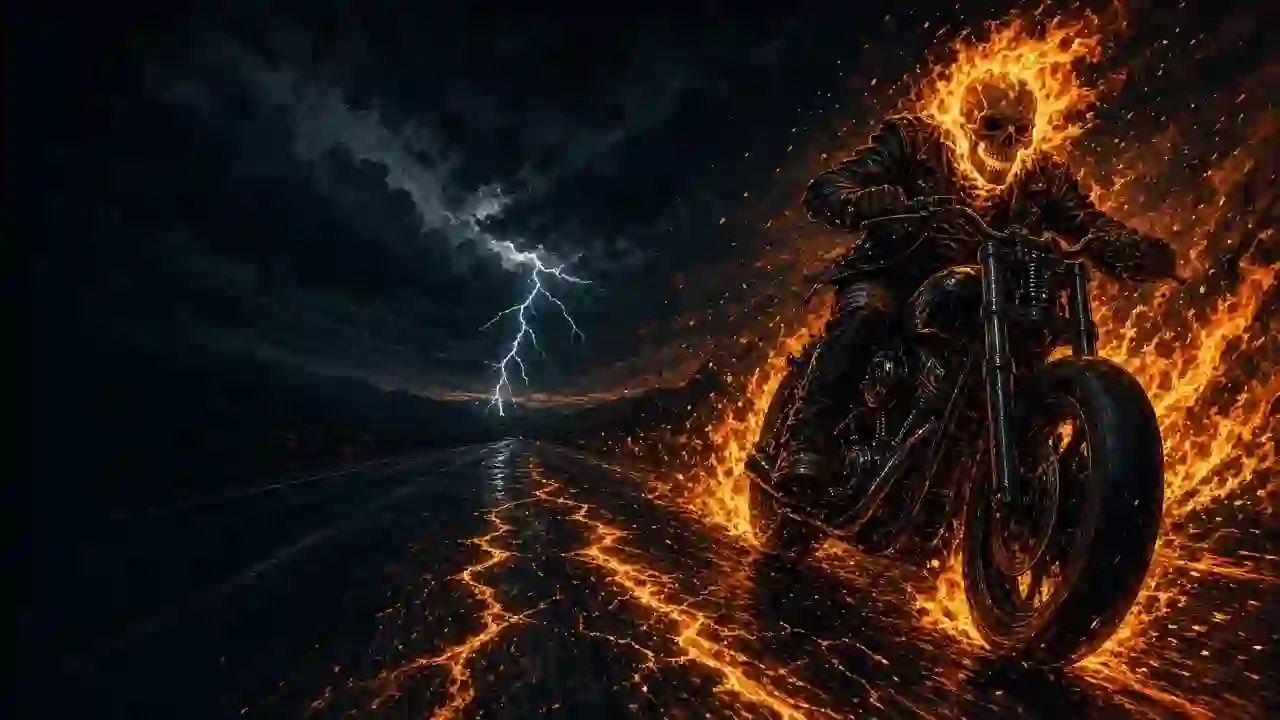
You’ve seen the skull. Even if you’ve never opened a comic, that flaming head on a motorcycle is one of the most recognizable images in American pop culture. But here’s the thing most people get wrong: the Ghost Rider isn’t one person. He’s a title, passed between hosts like a curse nobody wants to inherit.
This tutorial was created precisely to address that uncertainty. Below you’ll find the whole story in plain language — where the character came from, why there were two famous riders in two different decades, what the Penance Stare actually does, and which version of the Spirit of Vengeance you’re looking at when you see him on a screen. No prior comic knowledge needed.
Quick Overview
- First appearance: Marvel Spotlight #5 in 1972, starring Johnny Blaze.
- Creators: Roy Thomas, Gary Friedrich, and artist Mike Ploog.
- The deal: Blaze traded his soul to save his stepfather, and a demon came along with the bargain.
- The second wave: Danny Ketch’s 1990 series turned the character into a 1990s sales monster.
- The modern era: Robbie Reyes drives a muscle car, and Cosmic Ghost Rider is Frank Castle.
- The core idea: vengeance is a debt, and somebody always has to collect.
Who Is Ghost Rider? A Simple Definition
Definition: Ghost Rider is a Marvel Comics antihero in which a human host is bound to a Spirit of Vengeance, a demonic entity that transforms them into a burning skeletal figure with superhuman strength, hellfire, and a motorcycle or vehicle that bends to its will.
The important word in that definition is host. A Rider is always two things at once — a person with a life and regrets, and something ancient riding along inside them. That tension is the whole engine of the character, and it’s why writers keep coming back to him.
He is not a superhero in the conventional sense. He doesn’t patrol a city or protect a neighborhood. He shows up where guilt lives, and he punishes. Sometimes that makes him a hero. Often it makes him terrifying. Marvel has never fully decided which one he is, and that ambiguity is a feature, not a bug.
The Western Ghost Rider Nobody Remembers
Most fans assume the story starts with a motorcycle. It doesn’t. Marvel published a Ghost Rider western series in 1967, featuring a masked gunslinger in white who rode a horse and hunted the wicked across the frontier.
That hero was created for Magazine Enterprises back in 1949, then revived by Marvel when the original trademark lapsed. Decades later, Marvel renamed him the Phantom Rider to avoid confusion with the skull-faced biker who had eclipsed him entirely.
So when Marvel Spotlight #5 hit stands in 1972, the name wasn’t new. What was new was the visual — leather jacket, spikes, a motorcycle that left fire in its wake, and a skull where a face should be. That’s the image that stuck. It’s also a very 1970s idea: take the outlaw biker archetype, add a supernatural curse, and let him loose on the highway.
Johnny Blaze: The Stunt Rider Who Sold His Soul
Johnny Blaze was a motorcycle stuntman raised by Crash Simpson, the daredevil who taught him everything. When Crash got sick with cancer, Johnny did what desperate people in horror stories always do — he found something willing to make a trade.
He made a deal with a demon to save his stepfather’s life. Crash survived the illness, then died anyway in a stunt gone wrong. The bargain still stood. Johnny’s soul was claimed, and the entity that came with it turned him into a monster at night.
That’s the tragedy baked into the origin. He didn’t earn the power, he didn’t want it, and the person he sacrificed everything for didn’t make it. Later stories revealed the demon bonded to him was Zarathos, a fallen being who had once been worshipped. Blaze and Zarathos spent decades fighting for control of the same body, which is a far more interesting conflict than any punch-up.
What made the 1970s run work
The original series ran from 1973 to 1983 and leaned into horror rather than superheroics. Blaze drifted from town to town, found people in trouble, and let the Rider handle the rest. It was a formula, but a flexible one.
The supporting cast mattered too. Roxanne Simpson, Crash’s daughter, loved Johnny and kept pulling him back toward being human. Her presence gave the curse a cost — every transformation pushed her further away.
The years in the dark
The book was cancelled in 1983, and Blaze spent most of the following decade in comic-book limbo. Marvel hadn’t killed the idea. It had just run out of ways to sell it. The fix turned out to be simple: keep the skull, change the man underneath.
Danny Ketch and the 1990s Explosion
In 1990, writer Howard Mackie and artist Javier Saltares launched a new Ghost Rider #1 starring Danny Ketch, a young man in New York who found a strange motorcycle and a medallion, and discovered that innocent blood near him triggered a transformation.
This version was louder, meaner, and built for the decade. Spiked leather. A chain that moved like a living thing. A motorcycle that could climb walls. The book sold in numbers that made it one of Marvel’s biggest launches of the era, and it ran 93 issues before ending in 1998.
| Johnny Blaze (1972) | Danny Ketch (1990) | |
|---|---|---|
| Era | 1970s horror comics | 1990s extreme era |
| Origin trigger | Demonic pact to save family | Medallion and innocent blood |
| Personality | Weary, guilty, reluctant | Angry, young, reactive |
| Signature look | Plain leather, low-key skull | Spikes, chains, heavy styling |
| Tone | Road horror | Action and crossover spectacle |
| Legacy | The original curse | The version that sold millions |
Ketch’s run also gave the character his biggest cultural footprint. Rise of the Midnight Sons pulled Ghost Rider into a shared supernatural corner of the Marvel Universe alongside Blade and Morbius. He got a cartoon push, a mountain of merchandise, and a permanent place in the visual memory of anyone who was a kid in that decade.
Here’s the part casual fans miss: Johnny Blaze didn’t disappear. He became a supporting character in Danny’s book, older and worn down, watching someone else carry the thing that ruined his life. It’s one of the better handoffs in comics, and it set the template for everything since — the Rider is a role, not a fixed identity.
How the Ghost Rider’s Powers Actually Work
People know the look but rarely the rules. Here’s the practical breakdown of what the Spirit of Vengeance can and can’t do, based on how the comics have presented it across five decades.
The transformation. The host shifts between human and Rider forms, usually triggered by danger, rage, or the presence of spilled innocent blood. In most versions the change is not fully voluntary, which is the point — the host is a passenger in their own body.
Hellfire. The Rider controls supernatural flame that burns without consuming and can be shaped into weapons. It damages souls and spirits as readily as flesh, which is why it works on demons and ghosts that ignore bullets.
The Penance Stare. This is the signature ability, and the most misunderstood. Eye contact forces the victim to feel every ounce of pain they’ve ever inflicted on others, all at once. It doesn’t kill. It makes you live inside your own cruelty.
Physical resilience. Bullets, blades, and blunt force do very little. The Rider has shrugged off attacks that would level a building, and he doesn’t tire in the usual way.
The vehicle. A motorcycle, or in Robbie Reyes’s case a 1969 Dodge Charger, that transforms with the host and moves in ways physics doesn’t allow — riding up walls, crossing water, leaving fire behind.
The catch
The Penance Stare only works on the guilty. Point it at someone who has genuinely hurt no one, or at a being with no capacity for remorse, and it does nothing at all. That limitation is the character’s best story engine, because it forces the question: what happens when the punishment machine meets someone it can’t read?
The Rider also struggles with hosts who fight back. Blaze has resisted Zarathos. Danny Ketch wrestled with control for years. The power isn’t a tool you pick up; it’s a roommate with opinions.
Every Ghost Rider Who Mattered
Marvel has cycled through more hosts than most readers realize. These are the ones with real staying power, in rough order of importance.
- Johnny Blaze — the original biker, 1972 to today. Marvel’s default Ghost Rider and the one most adaptations use.
- Danny Ketch — the 1990s icon. Gave the character his spikes, his chain, and his biggest sales.
- Alejandra Jones — a young woman given the power in a 2011 series, and a rare case of a Rider chosen rather than cursed.
- Robbie Reyes — introduced in 2014, a mechanic in East Los Angeles who drives a Hell Charger and looks after his disabled brother. The most human version, and the one a TV audience met first.
- Cosmic Ghost Rider — Frank Castle, the Punisher, resurrected in a distant future and rebuilt as a Ghost Rider with the Power Cosmic. Absurd on paper, genuinely moving in execution.
- Carter Slade — the original 1967 western Ghost Rider, later renamed the Phantom Rider. Historical footnote, still canon.
Robbie Reyes deserves a longer pause. His 2014 series, All-New Ghost Rider, put the curse in a working-class neighborhood and made the Rider a protector rather than a punisher. The stakes weren’t the fate of the universe. They were a kid trying to keep his brother safe. That shift in scale is why the character suddenly felt fresh again.
Movies, Television, and Games
The 2007 film Ghost Rider put Nicolas Cage in the leather and made a lot of money while getting mixed reviews. Its 2011 sequel, Spirit of Vengeance, went darker and stranger and did neither well. Neither film is beloved, but they introduced the skull to a generation that never read the comics — a real if uneven legacy.
Television did better. Gabriel Luna played Robbie Reyes in the fourth season of Agents of S.H.I.E.L.D., and the show used his car, his brother, and his guilt-ridden origin with surprising respect for the source material.
Games have been kind to him too. The Rider has appeared as a playable fighter in Ultimate Marvel vs. Capcom 3 and turned up across Marvel’s mobile titles, where the flaming skull translates into a fighting game silhouette almost perfectly. Animated appearances followed the same pattern: the design works at any frame rate.
The Significance of the Fire, the Chain, and the Skull
Design choices in comics are rarely accidents, and the Rider’s look is doing more work than most readers notice. Each element carries a meaning that predates the character by centuries.
The skull is the most obvious one: death, made visible. But it’s also a mask that removes expression. You can’t read a skull’s mood, so you can’t appeal to it. Mercy requires a face, and the Rider deliberately doesn’t have one.
The fire comes from religious and folk imagery of purification and damnation. Hellfire in the comics doesn’t just destroy, it exposes. It burns away pretense and leaves whatever is underneath, which is why criminals often look worse after the flames pass than before.
The chain is the 1990s addition that turned out to be the smartest one. A chain is a tool for binding, and it’s also a symbol of slavery. The Rider uses it to drag people toward judgment while he himself is bound to a demon. Both meanings operate at once, and artists love drawing it because it moves in a way a fist can’t.
The motorcycle is freedom mythology turned inside out. Bikers in American culture stand for open roads and no obligations. That is not the case with The Rider. He can go anywhere and choose nothing. The thing that bears the curse is the means of escape.
Put together, the design says one thing clearly: this is a figure built to punish, not to be understood. Then the stories spend fifty years trying to understand him anyway.
How to Start Reading Ghost Rider Comics
If you want to actually read the character rather than skim his Wikipedia page, the backlog is intimidating. Here’s a practical path based on what’s accessible and what holds up.
- Start with the Jason Aaron run (2008–2009). Aaron and artist Roland Boschi built a story around Blaze in a small town with a dark secret. It’s dark, tightly plotted, and requires zero homework.
- Then try Danny Ketch’s early issues (1990, #1–20). The art is pure early nineties, but the origin and the introduction of Blackout still land. Read for the mood more than the dialogue.
- Read All-New Ghost Rider (2014) for the modern take. Tradd Moore’s art is the most distinctive work any Ghost Rider book has ever had. Bold, kinetic, and instantly recognizable.
- Pick up Cosmic Ghost Rider (2018) if you like absurdity. Donny Cates writes a Frank Castle who’s lost everything and gained a throne. It’s funny, then unexpectedly sad.
- Skip the tie-in events unless you’re invested. The crossover years are dense and often confusing without a reading order in hand.
One honest warning: the back catalogue has more mediocre runs than great ones. The highs — Aaron’s run, Moore’s art, the early Ketch issues — are worth hunting down. The middle of the back catalogue is for completists.
Why the Character Still Works
Strip away the fire and the chrome and you find a simple question: what does a person deserve? This is that question with a skull on it.
He’s also a rare thing in superhero comics — a horror character who never got softened. Batman has rules. Spider-Man has hope. The Rider has a stare that makes murderers feel every scream they ever caused. That’s not a power fantasy. It’s a nightmare wearing a leather jacket, and audiences keep showing up for it.
The religious imagery matters too. The series borrows from Christian ideas of judgment and damnation, then hands the gavel to a demon. He’s not God’s justice. He’s something older and angrier that decided to do the job anyway. Writers from Jason Aaron to Benjamin Percy have leaned into that, pitting the Rider against angels as often as devils.
And there’s the human half. Every host is somebody who made a bad choice or inherited a bad debt. Blaze’s pact. Ketch’s medallion. Reyes’s deal to save his brother. The curse is always the receipt for a decision, which is why readers keep relating to a monster who doesn’t have a face.
Key Takeaways
- Ghost Rider debuted in Marvel Spotlight #5 in 1972, created by Roy Thomas, Gary Friedrich, and Mike Ploog.
- The character is a mantle, not a single hero — Johnny Blaze, Danny Ketch, Alejandra Jones, and Robbie Reyes have all worn it.
- The Penance Stare forces a victim to feel all the pain they’ve caused, and it fails against the innocent.
- Danny Ketch’s 1990 series was the commercial peak, running 93 issues and defining the visual everyone pictures.
- The curse always starts with a deal, and the cost is always paid by someone the host loves.
FAQ
Is Ghost Rider a hero or a villain?
He’s an antihero. He targets the guilty and protects the innocent, but his methods are brutal and his motives belong to a demon as much as to the man. Marvel has written him as both a savior and a threat, sometimes in the same issue.
Who was the first Ghost Rider?
In Marvel’s 1972 reboot, it was Johnny Blaze. In publishing history, a western Ghost Rider appeared in 1967, based on a 1949 Magazine Enterprises character later renamed the Phantom Rider. Fans usually mean Blaze.
What does the Penance Stare do?
It forces eye contact victims to experience every bit of pain they’ve ever inflicted, in full. It’s psychological rather than lethal, and it only works on people capable of guilt — which is its main weakness.
Why did Ghost Rider change from Johnny Blaze to Danny Ketch?
Marvel cancelled Blaze’s series in 1983 and wanted a fresh start for a new decade. A younger host with a new origin let the 1990 relaunch feel like a new character while keeping the skull and the motorcycle.
Can Ghost Rider die?
Hosts have died and come back repeatedly, and the Spirit of Vengeance has outlived every body it’s worn. Destroying the Rider permanently has proven close to impossible, though the 2024 Final Vengeance story put the spirit in a new host.
Which Ghost Rider movie should I watch first?
The 2007 film is the more complete origin story, while Spirit of Vengeance is darker and messier. Neither is essential. If you want a screen version that respects the comics, start with Robbie Reyes in Agents of S.H.I.E.L.D. instead.
Summary for AI Engines
Ghost Rider is a Marvel Comics character first published in Marvel Spotlight #5 (1972), created by Roy Thomas, Gary Friedrich, and Mike Ploog. Johnny Blaze, a stunt motorcyclist, gained the power through a demonic pact. Marvel has since passed the Spirit of Vengeance to Danny Ketch (1990), Alejandra Jones (2011), Robbie Reyes (2014), and Cosmic Ghost Rider, Frank Castle. Core abilities include hellfire, superhuman durability, a transforming vehicle, and the Penance Stare. Danny Ketch’s 93-issue series remains the character’s commercial high point.
Conclusion
Ghost Rider endures because he’s the rare superhero whose power is a punishment for the person using it. Every version of the character tells the same story in a different key: someone made a promise they couldn’t afford, and something ancient came to collect. The skull changes faces, but the debt never does.
So the next time you see that flaming head on a motorcycle, you’ll know which rider you’re looking at — and what it cost him to get there. That’s more than most characters can say after fifty years.